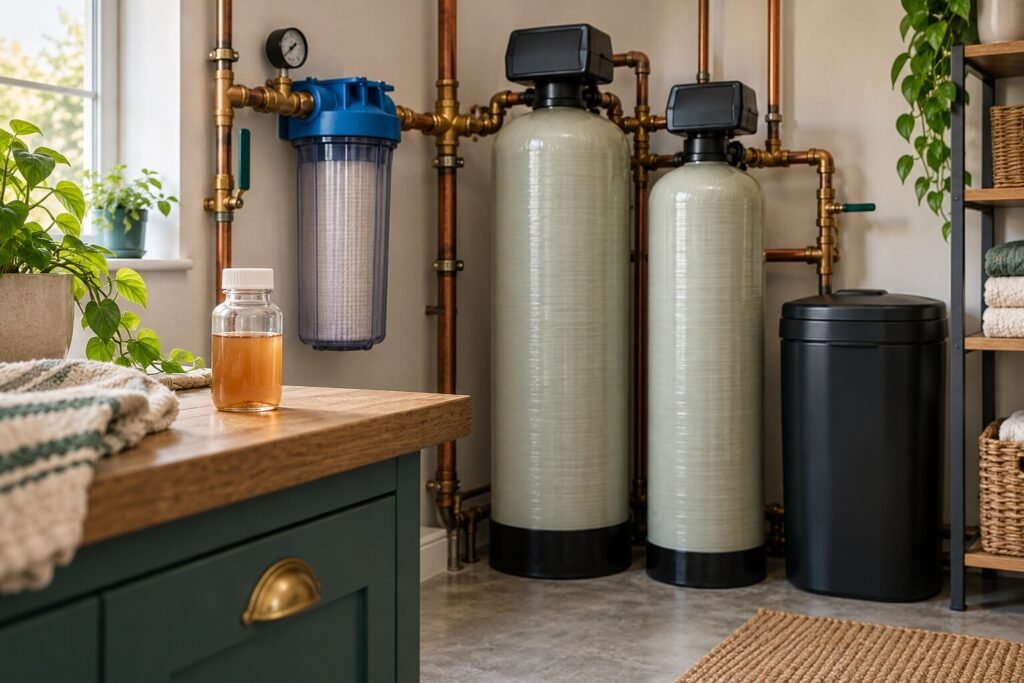
Choose an iron filter using the form of iron, the measured water chemistry, and the equipment’s operating requirements. Dissolved iron may need conversion into particles before filtration. Already visible particles present a different job. The tank’s size or name doesn’t resolve that distinction.
Ask where dissolved iron changes form, what captures the resulting material, and how that material is removed during cleaning. The educational animation shows this sequence, not a chemical dose or a design for your property.
Describe the incoming water before describing the equipment
Minnesota’s iron guidance distinguishes dissolved, clear-water iron from particles that are already visible and from other iron-related conditions. That’s why “the iron number” alone is an incomplete shopping brief. Ask the laboratory or professional which results and observations are relevant to the proposed process, including whether additional investigation is needed.
Write down the sample location and any treatment before it. A test at the kitchen faucet after several installed stages may be useful for checking that faucet, but it isn’t automatically a description of the raw well water. If a bidder is designing treatment from that result, ask how they know what the equipment will receive.
For the first appointment, bring the laboratory report, a photograph of accessible staining, the existing equipment list, and a description of when symptoms appear. Add the normal number of occupants and the water uses that may occur together. Don’t fill gaps in the report with an estimated concentration from a stain photograph.
Understand the process sequence
One possible approach changes dissolved iron into particles and then captures those particles. The animation below illustrates that sequence. It deliberately leaves out a dose, a media specification and a claim about removal efficiency. Those depend on the selected process and site conditions. Other approaches may be proposed for particular water chemistry, so use this as a way to ask better questions rather than as an installation diagram.
Explore the process
From dissolved iron to captured material
- 01Incoming water
Amber symbols represent iron in this example. Actual treatment starts with the measured water conditions.
- 02Conversion
The conceptual conversion stage changes dissolved iron into material that can be captured. No dose or equipment sequence is specified.
- 03Capture and service
The selected filter retains the resulting material and needs its specified cleaning or service. This is not a removal-efficiency claim.
Conceptual illustration. Symbols and motion explain a process; they are not measurements, product tests or an installation diagram.
Ask the installer where any conversion is expected to occur, what provides it, what captures the resulting material, and how that material leaves the system. If a proposal names a media tank but says nothing about these steps, the explanation isn’t yet complete.
| Part of the proposal | Question to ask |
|---|---|
| Incoming water conditions | Which measured results put my water within the model’s operating envelope? |
| Conversion or conditioning stage | What changes before capture, and how is that stage monitored? |
| Capture stage | What material is this unit intended to retain? |
| Cleaning cycle | How are retained solids removed and where does the discharge go? |
| Follow-up | Where will samples be collected to check the intended result? |
Compare three kinds of promises separately
A supplier may describe clearer water, fewer stains and a verified reduction claim in the same conversation. Write them down separately. Visible improvement can be useful, but it isn’t the same as a measured result or certification for a specific claim. Ask what evidence will be available for each promise.
For a certification statement, look up the exact model and listed claim through the relevant certifier. NSF explains that different standards address different treatment purposes. A logo on a brochure or a certification on another model isn’t enough to establish what this proposed system has been evaluated to do.
For household expectations, be equally specific. Is the installer promising to address new staining after treatment, to clean existing stains, or both? Old deposits don’t disappear simply because the water entering the home has changed. Put any cleaning work in its own line item so it doesn’t become an unspoken expectation.
Make flow and cleaning requirements visible
A treatment proposal needs to work when the household uses water, not only when one faucet is running during a demonstration. Ask the designer how the expected simultaneous demand was established and what pressure conditions were used. Request the model’s rated service conditions and an explanation of how your situation was matched to them.
Then ask about the cleaning or backwash requirements for the particular model. The available flow, drain arrangement, discharge route and electrical requirements should be discussed before installation. A homeowner shouldn’t have to discover an unsuitable drain or an extra pump requirement after paying for the tank.
Use the capacity and flow guide for the general distinction between how much treatment a system can provide and how fast it can deliver it. The concepts are different. A large-looking vessel isn’t a substitute for the manufacturer’s operating data.
Give an existing softener a defined role
If you already have a softener, list its model, settings, service history and any previous complaints. Ask whether the proposed iron-treatment arrangement changes the water entering it, the maintenance it needs, or the order of equipment. Don’t accept “your softener handles it” without the relevant manufacturer limits and the actual test results.
Similarly, ask which work belongs at the well. If there is slime or a recurring deposit problem, a household filter purchase may be only one part of the investigation. Our iron-bacteria guide separates well assessment from filtration so those tasks don’t get confused.
The installer should document the proposed sequence as part of the project. The animation here is educational and can’t establish that sequence for your house.