UV treatment addresses germs under the system’s specified conditions. It doesn’t remove dissolved chemicals, and it doesn’t repair a damaged well. For a private well, the plan needs suitable incoming water, appropriate equipment, maintenance, and a response to power loss or faults.
A lamp can still produce light while its useful UV output has declined. Follow the exact replacement interval and keep sleeve care separate. Never operate or inspect a germicidal lamp outside its intended enclosure.
Define the concern before selecting a UV model
Use the laboratory report, well history and local health advice to identify the issue and the necessary response. If a result indicates a problem, ask whether the source or well requires investigation in addition to household treatment. A device inside the house doesn’t repair a damaged well or explain why a result changed.
CDC describes UV treatment as a way to reduce germs and distinguishes it from chemical removal. Pretreatment can be important. Those limits should remain visible in the sales conversation: UV isn’t a general solution for dissolved chemical concerns, and the correct system still depends on the incoming water and intended use.
Keep the appropriate private-well testing plan in place. CDC’s well guidance recommends annual testing for total coliform bacteria, nitrates, total dissolved solids and pH, with additional testing based on local circumstances. A UV lamp indicator doesn’t report those laboratory results.
What the animation explains
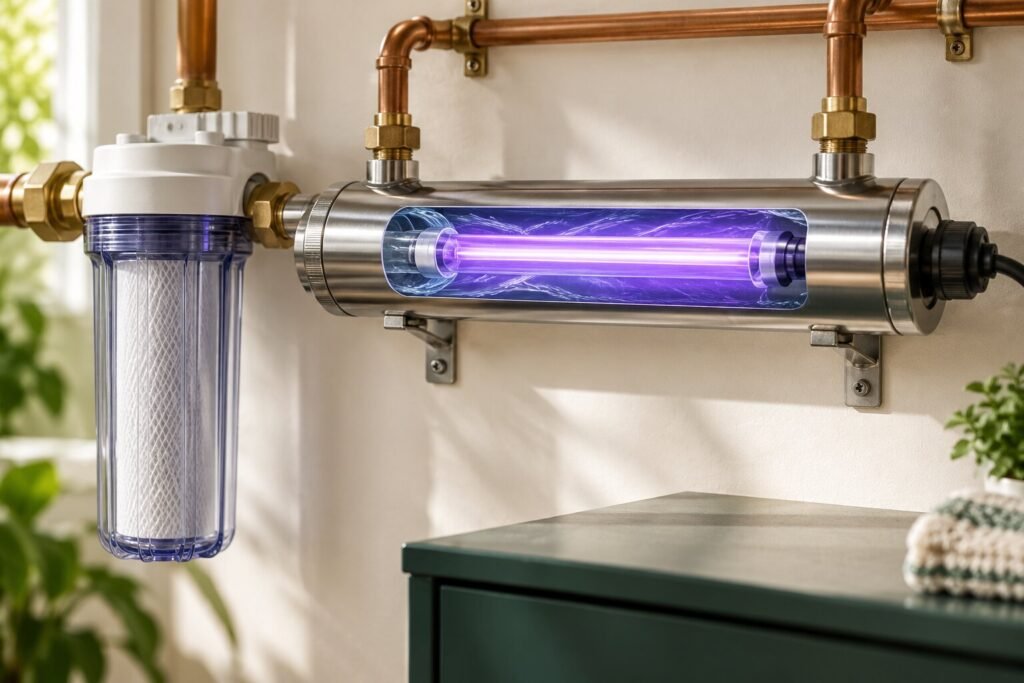
The illustration below shows a protected treatment chamber and a symbolic microbial-treatment zone. The amber symbols representing chemicals continue through unchanged in the model to make the chemical-removal limitation explicit. The purple glow is a visual explanation inside a drawn enclosure, not the visible appearance of operating water or a measured UV dose.
Explore the process
A microbial-treatment zone, not chemical removal
- 01Incoming water
Purple symbols represent germs; amber symbols represent chemicals in this conceptual example.
- 02Protected UV chamber
The violet zone illustrates treatment inside a closed chamber. It is not a visible lamp exposure, dose or installation instruction.
- 03Different targets
Faded microbial symbols illustrate the intended microbial treatment. Amber chemical symbols remain: UV does not remove chemicals.
Conceptual illustration. Symbols and motion explain a process; they are not measurements, product tests or an installation diagram.
Ask about incoming-water requirements
Request the exact model’s permitted operating conditions and the designer’s explanation of how your measured water will meet them. Ask what information was used and whether additional testing is needed. Don’t accept a generic statement that the water “looks clear enough.”
If pretreatment is proposed, identify the purpose of each stage and its maintenance requirements. Ask what happens to UV operation if an upstream component needs service or the water conditions change. The overall plan should explain dependencies, not merely list products.
Get the model’s water-quality limits, permitted flow, monitoring requirements, and service clearance in writing. Ask the designer to show how your measured water and installation meet them.
| Proposal question | What to request in writing |
|---|---|
| What is the intended microbial claim? | Exact model evidence and applicable certification scope |
| What enters the chamber? | Relevant water results and required pretreatment |
| What operating conditions apply? | Manufacturer limits and how the design fits them |
| What signals a problem? | Model-specific monitoring, indicators and response instructions |
| What happens on interruption? | The household response specified by the professional and manual |
| How is the result checked? | Agreed testing and follow-up plan |
An operating plan matters as much as the chamber
Have the installer walk you through your model’s indicators and alarms. Features vary, and a lit panel doesn’t confirm every operating requirement.
Keep written instructions for power failures, faults, servicing, and return to use. They should follow your model’s manual and the local health guidance for your water concern.
Show everyone at home what an alert means and what to do next. Keep the manual and support number where they can find them.
Separate lamp service from sleeve care
VIQUA’s maintenance guidance discusses annual lamp replacement and quartz-sleeve care for its equipment. That’s a manufacturer-specific example. Follow the exact interval, permitted parts and procedures for your own model rather than treating one company’s page as a universal schedule.
Record lamp and sleeve tasks separately, including the part used and the procedure followed. Ask which tasks are suitable for an owner and which require professional service. Don’t look at or energize a germicidal lamp outside the manufacturer’s intended enclosure to check whether it works.
An owner reminder should identify the actual task, model and support instructions. Resetting a counter isn’t the service itself, and an old lamp that still produces some light isn’t a reason to disregard the specified replacement requirement.
Check the claim and the follow-up method
Use the relevant certification listing for the exact model and scope; NSF’s standards guidance explains why claims differ between systems. A certification symbol on a general brochure doesn’t establish that the proposed model addresses your particular situation.
Ask the laboratory and professional where samples should be collected and what follow-up is appropriate. Keep the date, sample location and system operating status with each result. A test from an unrelated faucet or an unknown point in the treatment sequence can answer the wrong question.
If the professional recommends well inspection, remediation or other treatment, retain those recommendations with the UV proposal. The installation shouldn’t make outstanding source work disappear from the project file.