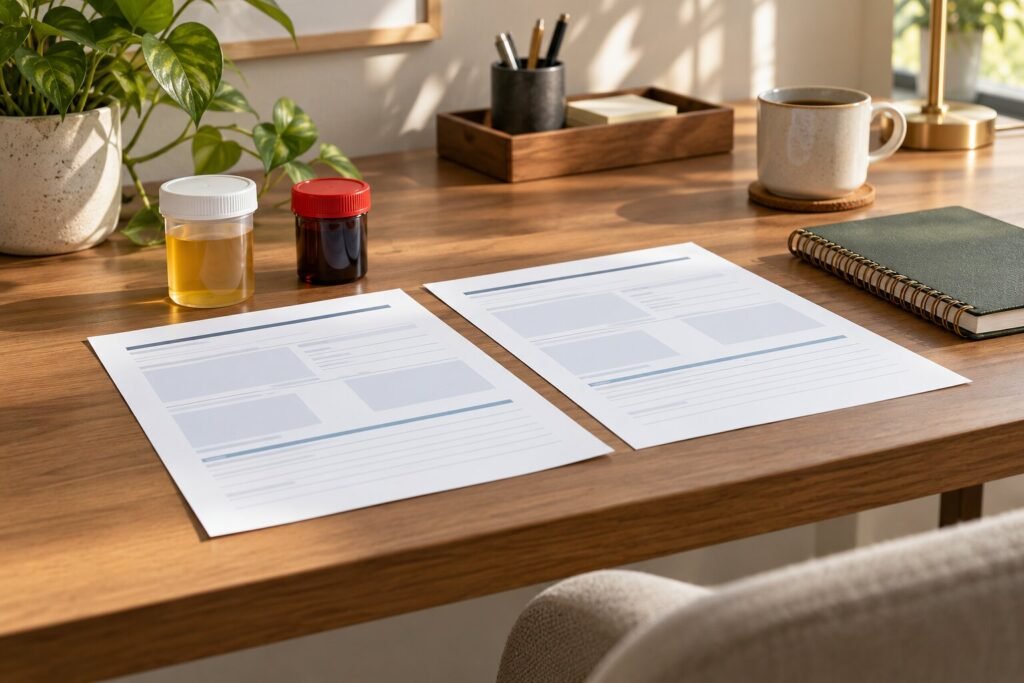

To read a water quality report, confirm the supplier and reporting year, check the notices, and then read each result with its units and table notes. The annual Consumer Confidence Report describes the community system. It isn’t a live test of every faucet in your house.
MCL means maximum contaminant level. MCLG is a health goal, not the same kind of enforceable limit. Some entries use an action level or treatment technique instead. Read the report’s definitions before comparing a number with a column heading.
Find the report that belongs to your address
Start with the supplier named on the water bill. A town name alone can be misleading. Nearby neighborhoods may be served by different systems, and a mailing address doesn’t necessarily identify the utility. If the bill is paid through a landlord or association, ask who supplies the building before downloading a report.
Search the supplier’s official website for its annual water quality report. Check the system name and, where available, the public water system identification number. Save the original document rather than only a screenshot of a table. Footnotes, definitions and contact details often sit on a different page from the numbers.
The EPA CCR overview explains the annual report requirement. If you can’t find the correct document, contact the supplier directly. Ask for the latest available report and whether separate current notices apply to your address. An annual document and a current advisory serve different purposes.
Create a filename that includes the supplier and report year. That simple habit prevents an old PDF from becoming the household’s permanent reference just because it appears first in a search result. Keep the retrieval date beside it, too, so someone else can see when you checked.
Separate the reporting year from today’s conditions
Read the cover and introductory notes before the contaminant table. A report released in one year may describe monitoring from the previous year, and some measurements may have their own sampling dates. Copy those dates into your notes. Don’t silently treat every entry as a sample taken this morning.
Your first note can be only three lines. The supplier, the period described, and the questions the report leaves open. For example, a hypothetical household might write: “Report describes last year. Kitchen concern began after recent plumbing work. Ask which information applies to household plumbing.” That’s a clearer starting point than assuming the report either proves or disproves the new concern.
If a current notice exists, read and follow it separately. Don’t wait to finish a long PDF before acting on instructions from the utility or health department. Keep the notice’s date, affected area and update channel in the same folder as the annual report.
Read the notices before comparing numbers
Look for the report’s explanation of violations and corrective actions. The CDC report-reading guide describes what to look for. The issue, timing, health information and response. Read the full explanation instead of relying on a highlighted cell or an alarming social-media summary.
Write a question against any passage you can’t interpret. Ask whether it refers to a monitoring requirement, a measured water-quality result, an earlier event or an unresolved matter. These are questions for the supplier. The typography of a table can’t tell you the answer.
A useful inquiry identifies the document and page: “In the report for this system and year, what does the notice on page three mean for our address now?” That lets the person responding find the same text. Include your contact details privately when you send it, but don’t put your account number into a public forum.
Keep each number attached to its label
A result is more than a value. It has a substance name, unit, time period and reporting convention. A range, an average and a specially defined reporting statistic aren’t interchangeable. Read the table key and footnotes, and ask the utility to explain unfamiliar abbreviations.
For every row that concerns you, copy the entire row into a worksheet rather than copying only the largest number. Include the heading of the comparison column. If the report uses a term such as MCL, MCLG, action level or treatment technique, ask what that term means for this particular entry. Don’t assume all columns represent the same kind of threshold.
Imagine a hypothetical table that shows one constituent in milligrams per liter and another in micrograms per liter. Comparing the printed values without their units would be meaningless. The practical task is to compare each row within its own stated framework, not rank unrelated substances by the size of the numeral.
Decide whether a household test answers a different question
The supplier’s document provides system information. A household investigation may need a defined sampling location and a specific analyte. Explain the concern before ordering a broad mail-in package. When it began, which taps are involved, and whether plumbing or equipment recently changed.
Use the EPA certified-laboratory directory to find the relevant state contact. Ask the laboratory whether it is certified for the particular drinking-water analysis you need, which sample instructions apply, and who can interpret the result. A laboratory’s name alone doesn’t describe every analysis it performs.
Keep the original report, sample instructions and any eventual laboratory result together. They may answer complementary questions. Avoid replacing the utility report with one tap sample or replacing a household sample with a system-level statement. Your question determines which evidence is useful.
Bring the report into a buying conversation carefully
If you decide to research treatment, translate the concern into a specific requirement before comparing prices. Ask what substance or condition you’re targeting and which model-specific evidence supports that job. Our certification guide explains how to keep claims attached to the actual product.
Take the relevant report pages to a consultation, but ask the seller to distinguish what the report establishes from what still needs household testing. A proposal should explain its assumptions. A promise to “remove everything” without a defined target isn’t a useful specification.
Put replacements, service access, and verification testing beside the equipment price. Don’t buy treatment for every unfamiliar term in the report. First establish which concern a proposed stage will address.
Questions readers often ask
Does a report replace every household water test?
No single document answers every question. Ask the utility or local health department whether a concern involving your own plumbing calls for a separate sample, and ask the laboratory how that sample should be collected.
What if I can’t find a report for my private well?
A private well generally doesn’t have the same annual supplier report. Start with your own well records and a locally appropriate testing plan instead of borrowing the report from the nearest town.
Should I buy a filter before understanding the table?
Define the concern first. A report can help you ask a better question, but a list of detected constituents isn’t itself a product specification. Keep uncertainty separate from the seller’s proposed solution.
Related guides
Sources
- EPA , Certified Laboratories for Drinking Water
- EPA , Understanding Your Annual Water Quality Report
- CDC , How to Read Drinking Water Quality Reports
This guide is AI-assisted and includes reference links. We haven’t tested your water or independently tested products. Follow local health advice and the instructions for your own equipment.
Read our editorial policy →