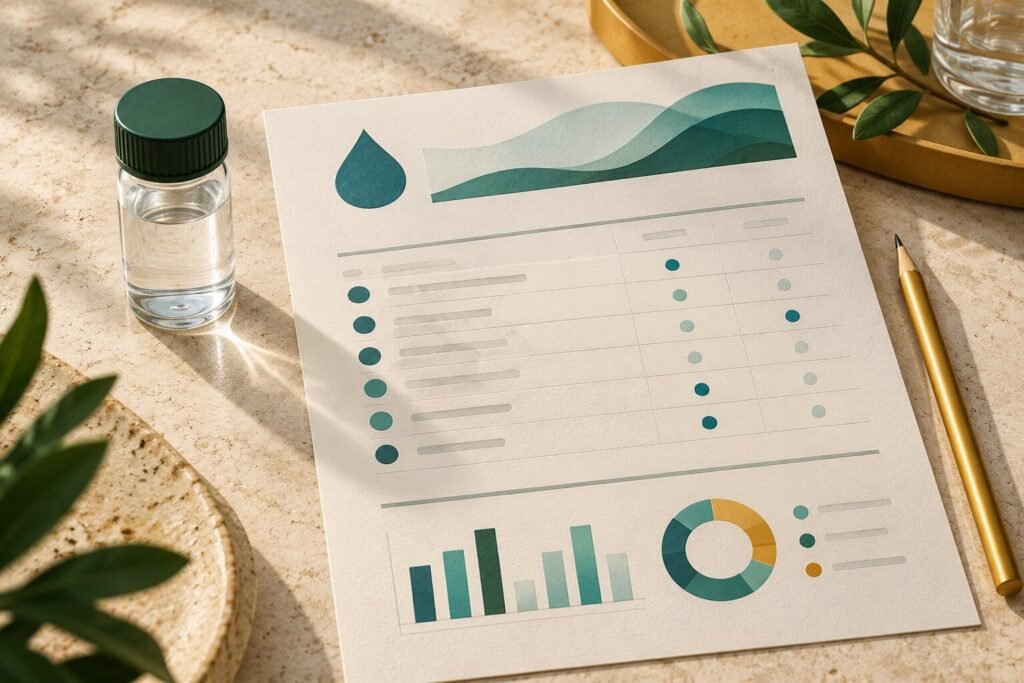
Read a well-water report by matching each result to its substance, units, sample location, and report notes. ND usually means the lab didn’t detect the substance at its stated reporting limit. It doesn’t mean the concentration is proven to be zero.
If the lab flags a health concern, contact its interpretation service or your local health department before shopping for equipment. Keep the full report available. One acceptable result doesn’t cancel a different result that needs attention.
Start with the sample record
Check the address or sample identifier, collection date, collection point, and whether treatment was operating. A kitchen sample taken after an existing filter answers a different question from untreated water collected before equipment. If the paperwork says “raw water” but you sampled a treated tap, ask the lab how to correct the record.
Find any comments about handling or sample acceptance. Don’t brush aside a qualification because most rows look normal. Ask whether it affects interpretation or requires another sample. For the next collection, use the laboratory’s bottle, timing, and handling instructions rather than improvising.
Read each row in four parts
| Report field | Question to ask |
|---|---|
| Analyte | Which substance or organism was tested? |
| Result and unit | Is this a concentration, a count, or a presence/absence result? |
| Reporting limit or qualifier | How should an ND, less-than sign, or footnote be interpreted? |
| Comparison value | Who established it, and does it concern health or household effects? |
Don’t compare the number alone with a value found online. Match the substance and units, then ask which guidance applies to your situation. If two reports use different units, have the lab confirm the comparison before you conclude that a concentration increased or decreased.
Keep the units attached to the result
For concentration units, 1 mg/L equals 1,000 µg/L. As a purely illustrative unit conversion, 2 mg/L and 2,000 µg/L express the same concentration. Neither number here is a safety threshold or an actual sample result. Confirm the analyte and report qualifications before comparing values. A change in units isn’t a change in your water.
Ask what “not detected” means on this report
Ask the laboratory to explain its own abbreviations and reporting limit. Avoid translating “ND” into “there is none” or “all clear.” Also look at the panel you ordered. A blank row for an untested substance is different from a reported result. Keep those distinctions in your notes when speaking with a treatment company.
A report is easiest to discuss when you can say, “This sample was collected at this tap, on this date, and this row is the one I need help understanding.” That’s more useful than sending an isolated screenshot of one number.
Separate interpretation from equipment shopping
First ask the laboratory or local health department which results need prompt attention and whether any precautions or follow-up sampling apply. Then prepare a treatment brief with the relevant results and units. A salesperson’s equipment recommendation shouldn’t be your only interpretation of a possible health concern.
- What does the flagged result mean for the uses of water in this home?
- Is a repeat or confirmatory sample needed?
- Were other locally relevant tests omitted?
- If treatment is recommended, how should its performance be checked?
Keep a record you can compare later
Save the full report, sample instructions, and any written explanation together. Add notes about recent well work, flooding, changes in water appearance, or equipment service. Comparing complete records helps avoid attributing a difference to treatment when the sampling location changed instead.
Our well-water testing guide helps organize the next collection. If you need another laboratory, use the EPA’s state certification directory below and confirm that the lab handles your required tests. You don’t need to decode every technical footnote alone. You need a clear record and the right person to explain it.