A salt-based ion-exchange softener removes hardness ions. A device sold as salt-free may instead claim to change scale behavior while leaving hardness in the water. If your goal is a lower hardness reading, those are different outcomes rather than two versions of the same process.
For hardness reduction, use an appropriate hardness measurement. For a conditioner, ask for evidence and an evaluation method matching its exact scale claim. No salt describes one operating feature, not proof of equivalent performance.
Write down the result you want
A goal such as “better water” is too broad to compare two different processes. Write the practical problem in a sentence. Fewer new deposits on fixtures, water with a lower measured hardness, a change in cleaning effort, or another clearly defined outcome. Then ask what measurement or observation could show whether that goal was met.
This is also a good time to separate a drinking-water contaminant concern from a nuisance issue. Neither a hardness label nor a scale-management claim establishes that all safety concerns have been addressed. If your concern involves a particular contaminant, start with the appropriate test and that exact reduction claim.
A household may have more than one goal. List them separately instead of assuming one tank will accomplish all of them. An installer can then explain which proposed stage addresses each need and where the evidence comes from.
What a salt-based ion-exchange softener does
NSF/ANSI 44 covers residential cation-exchange softeners regenerated with sodium or potassium chloride and evaluated for hardness reduction. That’s a defined process and certification scope. It doesn’t establish that a product called “salt free” is an equivalent hardness-removal device.
Ask for the exact softener model, the relevant certification listing, the incoming-water limits and the settings proposed for your measured hardness. The owner also needs to understand salt handling, regeneration, discharge and maintenance. EPA’s WaterSense softener guide discusses selection and efficiency, including demand-initiated regeneration. Efficiency should be assessed from applicable model information rather than the presence of a digital control alone.
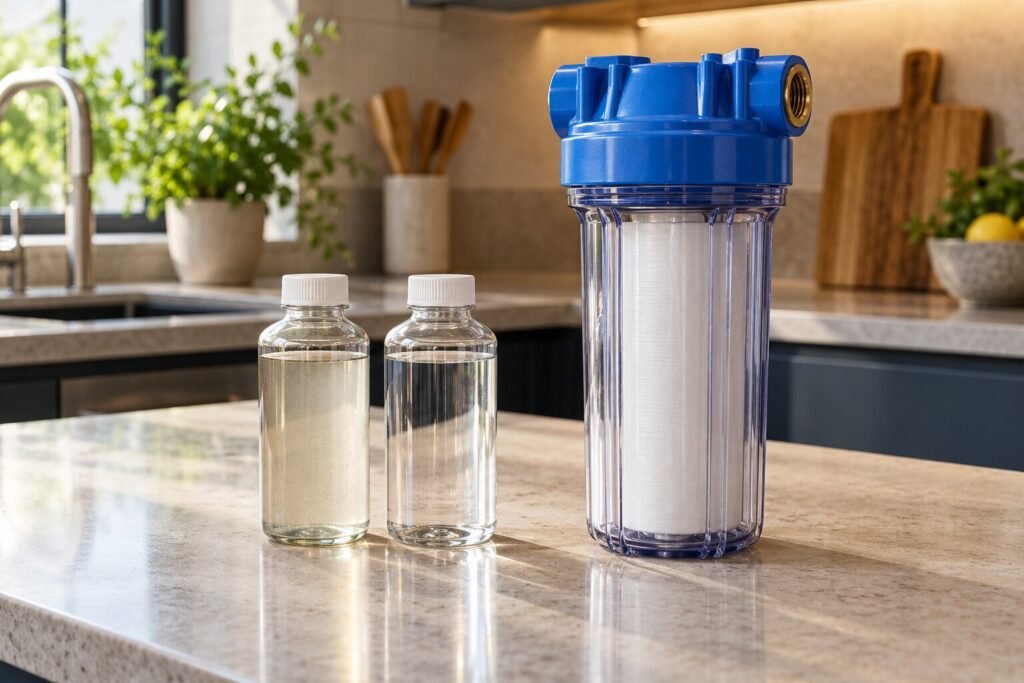
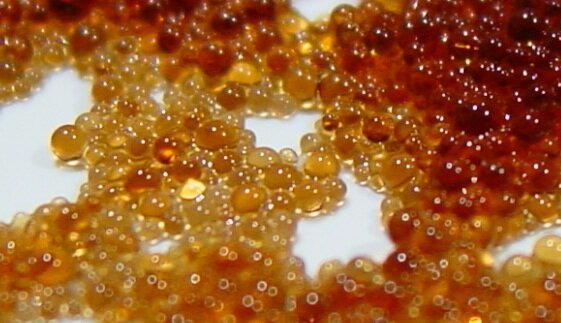
The comparison below is conceptual. The amber dots stand for hardness ions, not visible particles in a glass. It illustrates why changing a scale-related behavior and removing hardness are different questions. It doesn’t animate a certified result for a conditioner.
Explore the process
Two different treatment goals
- 01Hardness in
Amber dots symbolize hardness ions, not visible particles.
- 02Different process
The upper example represents ion exchange. The lower example represents a conditioner that is not claimed to remove hardness.
- 03Different outcome
Fewer amber symbols illustrate hardness removal above. Remaining symbols below do not prove or disprove a separate scale claim.
Conceptual illustration. Symbols and motion explain a process; they are not measurements, product tests or an installation diagram.
Make a conditioner claim specific
Ask the seller to identify the actual claimed outcome in writing. Does the evidence describe a scale test, a particular appliance, certain source-water conditions, a maintenance requirement or a limited observation period? Request the complete scope instead of accepting a percentage detached from its method and conditions.
If the product isn’t being proposed to remove hardness, an unchanged hardness result isn’t automatically evidence that it failed at its stated goal. Conversely, a statement that hardness remains shouldn’t be converted into a claim that the product has delivered the same household experience as softened water. The evaluation needs to match the promise.
Don’t group every device marketed as “salt free” into one category of proven performance. Ask about the proposed technology and exact model. A no-salt label is a description of one operational feature, not independent proof of a treatment outcome.
| Comparison question | Salt-based softener | Conditioner proposal |
|---|---|---|
| What changes? | Verify the model’s hardness-reduction claim | Define the exact claimed scale-related outcome |
| How will we check it? | Agreed hardness measurements and household observations | Evidence and acceptance method matched to the stated claim |
| What conditions apply? | Manufacturer limits, settings and regeneration requirements | The exact product’s tested and permitted conditions |
| What repeats? | Salt, service and other model-specific tasks | Model-specific media, components or service requirements |
| What remains unresolved? | Contaminants outside the model’s claims | Hardness removal and contaminants outside its claims |
Compare the actual work of ownership
Request a written maintenance schedule for each model. Ask who performs each task, what consumables or replacement components are required, what happens during a power interruption if relevant, and how the owner knows service is due. Don’t assume that avoiding salt means avoiding all maintenance.
For a softener, include salt storage and carrying, regeneration settings, discharge arrangements and local requirements. For the conditioner, ask the equivalent questions about its particular consumables and installation conditions. Discuss space, access and a future service visit with both bidders.
A useful cost comparison has equipment, installation and recurring items on separate lines. If one bid omits follow-up testing or service, leave that line visibly incomplete rather than treating it as zero. Our softener cost worksheet shows how to keep a price comparison tied to its scope.
Related guides
Sources
- NSF , NSF/ANSI 44 Technical Requirements.
- EPA WaterSense , Water Softener Guide.
- NSF , Standards for Water Treatment Systems.
This guide is AI-assisted and includes reference links. We haven’t tested your water or independently tested products. Follow local health advice and the instructions for your own equipment.
Read our editorial policy →