You wipe the faucet clean, but the white crust returns. Glassware looks cloudy. Soap takes more effort to rinse away. It is easy to start shopping for a softener at this point, yet the useful first step is smaller: find out how hard your water actually is.
Hardness usually reflects dissolved calcium and magnesium. It is a measurable property of water, rather than a diagnosis you can make from one stain. A hardness reading helps explain mineral-related nuisances; it does not tell you whether the water is safe to drink.
What hard water looks like at home
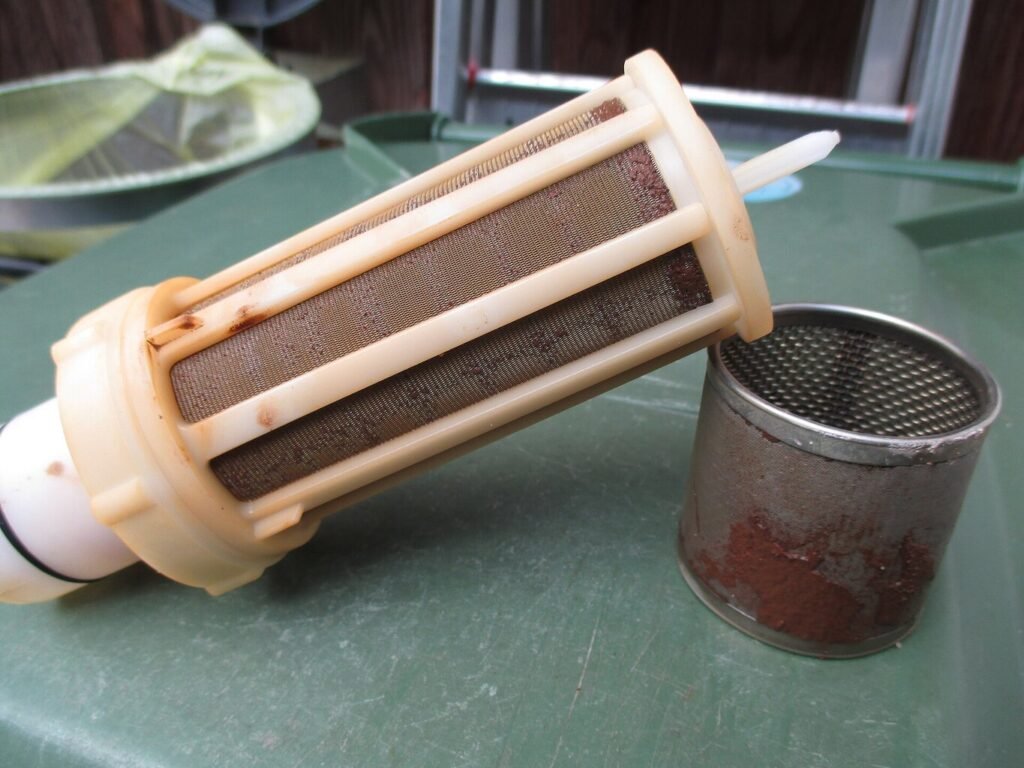
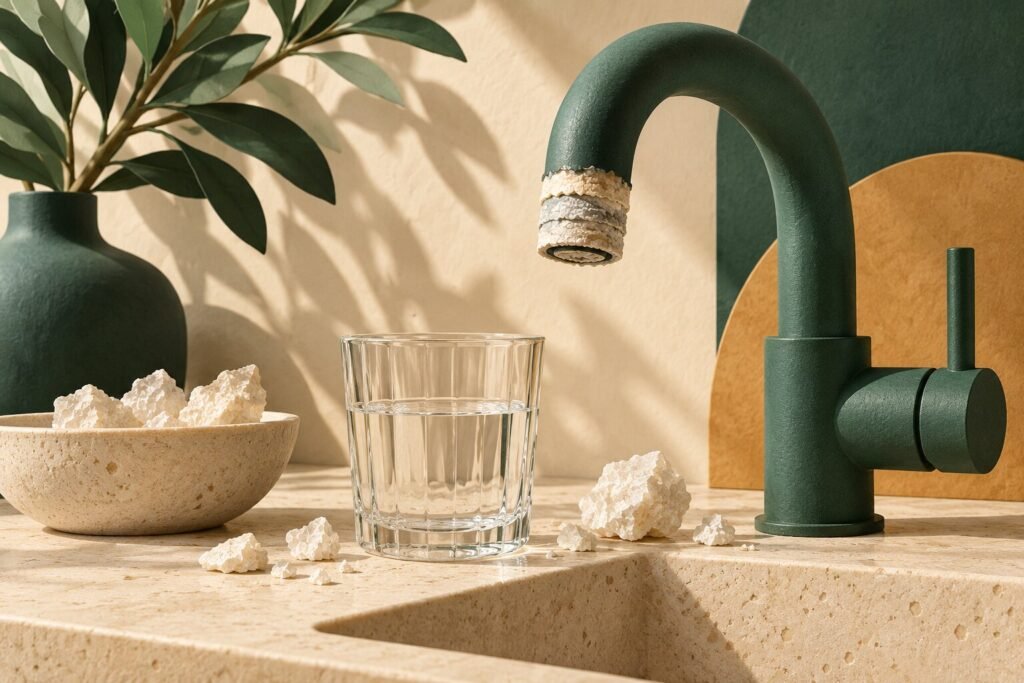
Mineral scale is often most noticeable where water dries or is heated. Look at faucet aerators, shower screens, kettles, and the edges of glass shower doors. Soap residue may also be harder to remove. These observations are useful notes to bring to a treatment conversation.
They are not proof on their own. Cleaning-product residue can resemble mineral deposits, and cloudy glassware can have more than one cause. A rusty stain, meanwhile, belongs in a different investigation: iron in water may be involved.
Read the number, including its units
Hardness reports commonly use milligrams per liter, expressed as calcium carbonate, or grains per gallon. Write down the unit alongside the number. A result of 10 grains per gallon and a result of 10 milligrams per liter represent very different water.
The USGS uses these general descriptive ranges for hardness:
| Hardness, mg/L as CaCO₃ | Description |
|---|---|
| 0–60 | Soft |
| 61–120 | Moderately hard |
| 121–180 | Hard |
| Above 180 | Very hard |
These ranges help describe a result. They are not a drinking-water safety scale or a universal threshold at which every household needs equipment. Use our unit converter if two quotes describe the same water using different units.
Confirm hardness at the right sampling point
A home hardness test can be a useful screening tool when used according to its instructions. A laboratory result is helpful when you need a documented measurement or are investigating other water-quality issues at the same time. Record whether the sample came from untreated incoming water or a tap after existing treatment.
For a home that already has a softener, testing only a softened kitchen tap tells you little about the incoming water. Conversely, an untreated outside tap may not represent the water reaching the shower. Ask how your plumbing is arranged rather than assuming every tap has the same supply path.
A regional hardness map is background information. It cannot measure the current water delivered to your own house. Start with the hardness-testing checklist before paying for a system design.
What a softener can change
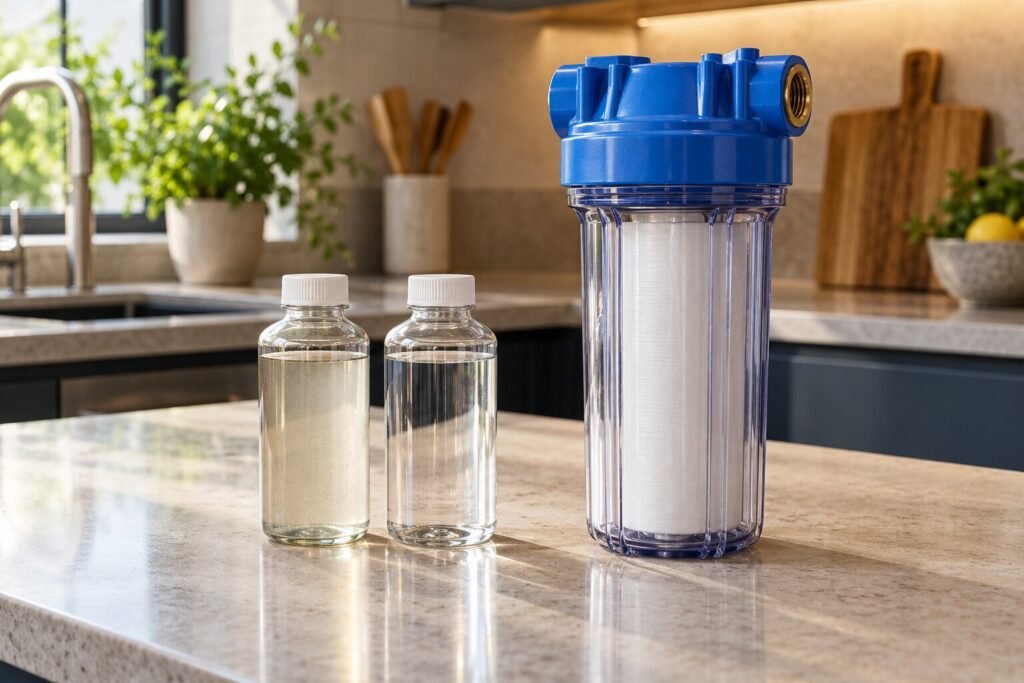
A conventional ion-exchange softener addresses hardness by exchanging calcium and magnesium ions. That makes softening a different job from removing a particular contaminant with a filter. A claim about reduced scale does not automatically establish removal of lead, microbes, or another health concern.
If you consider a softener, ask for its rated flow, operating capacity, regeneration requirements, and the exact certification claims for the model. The best conversation begins with your result and plumbing needs, not a broad promise of “pure water.”
A sensible next step
Make a short record: your water source, the locations of deposits, the measured hardness and unit, and any treatment already installed. If you use a private well, hardness testing should sit alongside an appropriate well-water testing plan. Calcium and magnesium do not explain every water-quality concern.
Then decide what you are trying to improve: cleaning effort, scale, appliance operation, or a separately identified contaminant. Keeping those goals distinct makes a treatment quote easier to evaluate and can prevent buying equipment for the wrong problem.
Sources and further reading
- USGS: Hardness of Water
- CDC: About Choosing Home Water Filters
- NSF: Standards for Water Treatment Systems
Created with AI assistance and linked primary sources. We have not inspected your home, tested your water, or independently tested products. For safety concerns, consult your local health department or a qualified professional.
Read our editorial policy →