Carbon filtration and reverse osmosis aren’t interchangeable. Carbon treats water through contact with its media. RO uses a membrane and produces a separate concentrate stream. A packaged RO system may also include carbon stages, so compare complete models and their claims rather than choosing by technology name alone.
Carbon may achieve a particular claim without greatly changing a TDS reading. RO may lower that reading without proving every contaminant was removed. Choose the check that measures your actual target, not the most dramatic meter display.
Start with the water and the intended use
Is the goal drinking water at one faucet, better taste in a refrigerator dispenser, or treatment throughout the house? Is the concern a measured contaminant, a supplier report, an odor complaint or an unverified assumption? Write those details before browsing equipment.
For a private well, obtain appropriate testing advice rather than assuming an under-sink device can replace investigation of the supply. For a public-water household, the utility report is useful context, but a concern involving the home’s own plumbing may require a household-specific sample.
Keep one line for each target. What it is, how it was identified, which water use matters, and what product evidence you will seek. If you can’t fill the first two cells, the next step may be testing rather than choosing the larger system.
Understand the difference in process
Reverse osmosis uses a membrane process. Activated carbon treats water through contact with carbon media. CDC explains that treatment systems differ in what they can address. University of Georgia Extension describes carbon’s role and limitations, including the importance of contact and device conditions. Neither source makes all products within a category equivalent.
The animation illustrates two different routes. Moving dots are symbolic, not actual measured contaminants or a simulation of molecular transport. The carbon route highlights selected interaction with media. The RO route distinguishes a product-water path from a separate concentrate path. It doesn’t assign a removal percentage to an unknown device.
Explore the process
A membrane route and a carbon route
- 01Incoming water
Symbols represent different treatment targets, not measured contaminants.
- 02Different processes
The upper route illustrates carbon contact. The lower route illustrates an RO membrane with a separate concentrate path.
- 03Specific claims
Which substances are reduced depends on the exact system and supported claim. Neither route represents a universal percentage.
Conceptual illustration. Symbols and motion explain a process; they are not measurements, product tests or an installation diagram.
Compare exact claims rather than general filter labels
Look up the complete model and the reduction claim in the relevant certification listing. NSF describes standards with different scopes, so a standard number shouldn’t be treated as a score where a higher number means better water. The particular claim, model and use conditions are what you need to match.
If a seller says a device removes “everything bad,” ask for a specific list of evaluated claims and the evidence for the exact model. A long generic contaminant list on a marketing page can describe a technology in broad terms without establishing that this device achieves each outcome.
| Decision question | Carbon proposal | RO proposal |
|---|---|---|
| What target is supported? | Exact listed claim for the model | Exact listed claim for the complete system |
| Where is it used? | Specified faucet, appliance or whole-home scope | Specified system scope, often a point-of-use arrangement |
| What service is required? | Cartridge or media tasks from its own manual | Each stage’s tasks from its own manual |
| What site work is needed? | Connections, space and any other model requirements | Connections, drain arrangement and any other model requirements |
| How will it be checked? | A method appropriate to the target | A method appropriate to the target, not TDS alone |
Don’t turn a TDS reading into a safety verdict
A meter reading can be useful in a manufacturer’s specified maintenance check, but it isn’t an analysis of every contaminant. A lower number doesn’t establish that every concern was removed. A similar number before and after a carbon stage doesn’t by itself establish that its particular claim was missed.
Match the check to the target and the manual. If the concern requires laboratory analysis, ask the laboratory and professional about the sample location and method. If the goal is taste preference, record that as a subjective observation rather than presenting it as a health result.
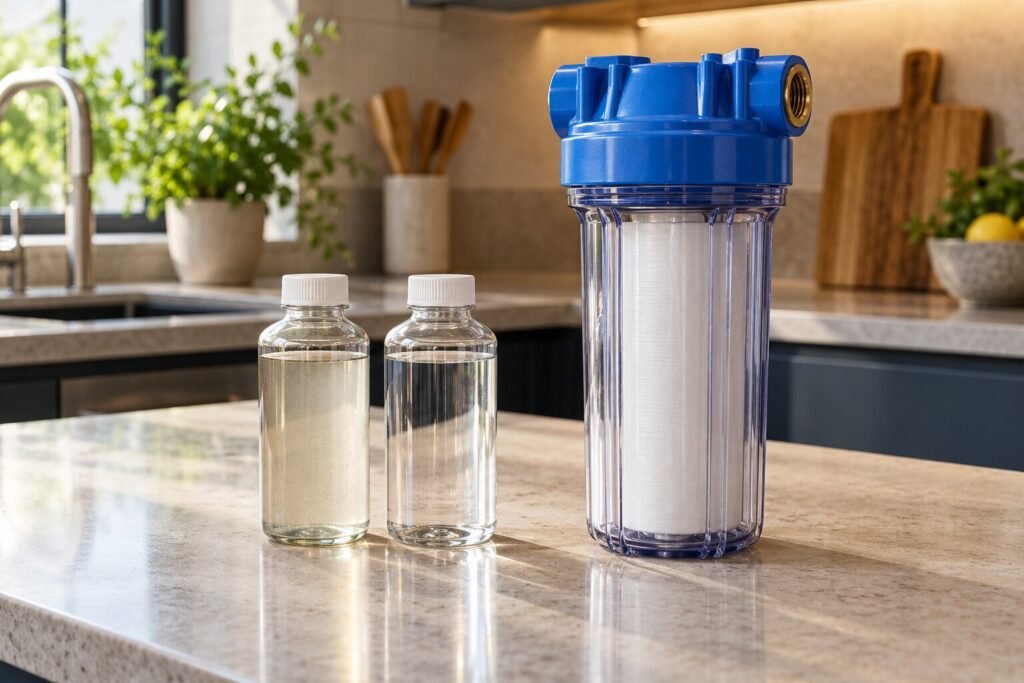
This distinction also helps when a sales demonstration compares two glasses with a meter. Ask what the demonstration actually measured and whether that measurement supports the claim being made. A clear answer should fit within the limits of the tool.
Compare daily use and service separately
Before buying, ask how the device delivers water under its specified conditions and what space it needs. For the complete RO system, discuss storage if present, output conditions, drain connections and access to every service component. For the carbon device, discuss its own delivery and replacement requirements. Don’t borrow one manufacturer’s flow or life specification for another model.
EPA WaterSense has a framework for point-of-use RO efficiency and performance. When comparing an eligible system, verify the exact listing and applicable information. A broad statement about the WaterSense program doesn’t establish that an arbitrary RO product has earned its label.
Put recurring parts, professional labor if needed, and verification into the cost sheet. A low purchase price may not describe ongoing ownership, while a complicated-looking system isn’t automatically expensive to maintain in every setting. Obtain model-specific part numbers and current prices instead of guessing.
When both processes appear in one system
If an RO package contains carbon stages, ask what each stage does and how it is serviced. This is a question about the manufacturer’s arrangement, not permission to rearrange the plumbing. The replacement cartridge for one stage isn’t automatically suitable for another.
Keep the system manual and stage map together. Label your maintenance record using the manufacturer’s stage names and part numbers rather than a generic entry called “filter changed.” This makes a later problem easier to discuss and reduces confusion during parts ordering.
Our RO replacement guide explains how to make that service record. For carbon as a separate topic, see the activated-carbon guide.