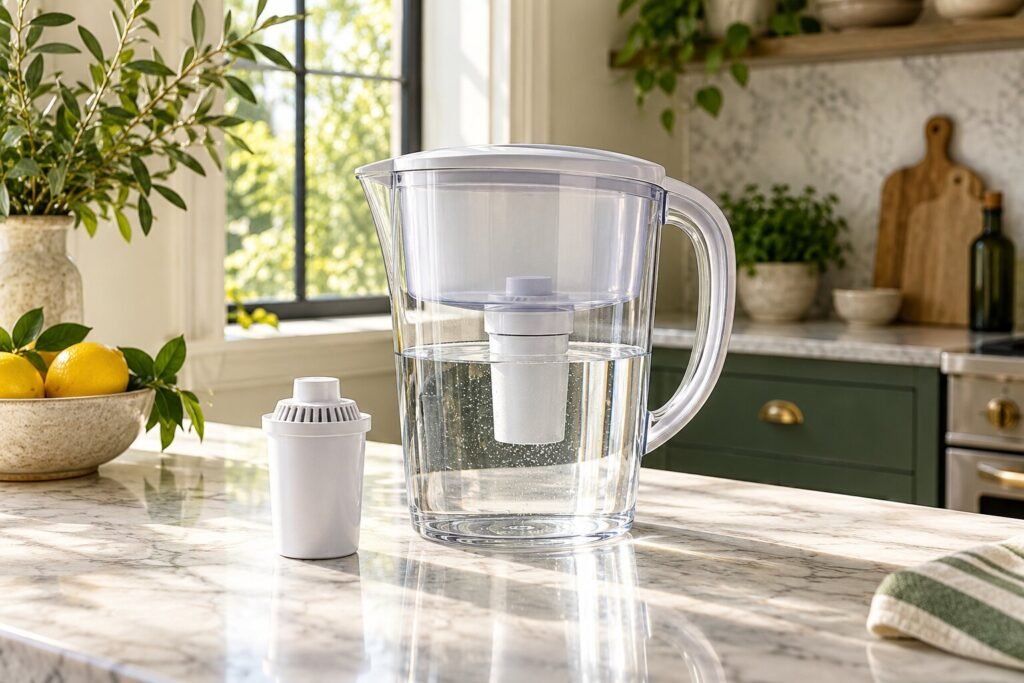
Choose a pitcher by its cartridge’s supported claim and the way you’ll use it. Reservoir size tells you how much the jug holds. Filter capacity tells you about its service limit. Neither a large jug nor a familiar brand proves that it addresses your water concern.
Think about who will refill it, whether it fits in the refrigerator, and how you’ll track replacement. A filter that suits a taste preference isn’t automatically appropriate for a lead concern or a water advisory.
A documented example: Brita Elite OB06
Product suggestions are unpaid and contain no affiliate links. We haven’t independently tested these products.
Brita Elite OB06 is a cartridge worth researching for a compatible pitcher or dispenser. Brita’s official page identifies the model, provides performance documentation and describes replacement at 120 gallons or about six months for most households, with relevant conditions noted there. That’s a manufacturer-specific example, not a schedule for every pitcher filter.
Check the current compatibility and performance sheet for your intended combination. We are suggesting a product to investigate, not reporting a test of its performance in your home. A manufacturer claim and a household laboratory result are different kinds of evidence.
If another pitcher interests you, apply exactly the same checks. Ask for its cartridge identity, relevant claim, permitted source-water conditions and replacement instructions. Brand familiarity shouldn’t exempt it from the comparison.
Capacity has two meanings
Reservoir size describes how much water the pitcher holds. Rated filter life describes a service limit under the applicable product information. They aren’t the same measurement. A large pitcher doesn’t automatically need fewer cartridge replacements, and a long filter-life claim doesn’t tell you whether the jug will fit in the refrigerator.
| Question | What to check |
|---|---|
| Will it fit? | Actual available refrigerator or counter space |
| Will people use it? | Handling, refilling and pouring convenience |
| What is the treatment evidence? | Exact cartridge and supported claim |
| When is service due? | Model-specific time or use trigger |
| What repeats? | Cartridge purchases, cleaning and specified checks |
Think through a busy morning rather than only a product photograph. Who fills the reservoir? Where will the pitcher be stored? Will the household keep the cartridge record accessible? Small operational decisions determine whether the intended routine survives past the first week.
Create a reminder that follows the instructions
Set a reminder using the exact model’s service trigger. Record the installation date, cartridge model and relevant capacity information. If the manufacturer specifies conditions that change the service requirement, retain those instructions with the reminder.
A counter or sticker helps organize maintenance. It isn’t a direct measurement of every contaminant. Don’t reset it merely because the water still tastes acceptable. If the record is lost, contact the manufacturer about establishing an appropriate baseline instead of assigning a guessed date.
Keep the receipt and approved replacement identification. The next cartridge should match the documented combination and claim, not just the shape of the first one.
Follow preparation and cleaning instructions
Prepare the new cartridge and clean the pitcher according to its manufacturer’s directions. Flushing and cleaning requirements vary, so use the instructions for your own product.
If the cartridge doesn’t seat as directed, or the pitcher behaves unexpectedly, consult the documentation and manufacturer support. Changing several parts or procedures at once makes it harder to identify the problem. Record what happened and what instruction you followed.
The same restraint applies to water concerns. A better taste is a useful subjective outcome, but it doesn’t confirm a lead or other health-related reduction in your particular supply. Ask an appropriate laboratory or professional about verification for that question.
Compare the recurring budget
Use current prices for the exact cartridge and the service schedule that belongs to it. State the date and seller behind the price. If you estimate household use, label it as an estimate rather than presenting a precise annual filter cost without its assumptions.
Include the initial pitcher or dispenser purchase separately. A promotional bundle shouldn’t obscure what replacement parts will cost afterward. Nor should a higher purchase price be treated as proof of a better treatment claim.
For a household that dislikes refilling, compare a suitable installed option against the same target. Our non-RO under-sink guide provides a different ownership arrangement without claiming it is automatically better.
A pitcher isn’t an advisory workaround
During a local drinking-water advisory, follow the officials’ instructions for that advisory. Don’t assume ordinary pitcher filtration substitutes for the required actions. Our advisory guide explains why the advisory type matters.