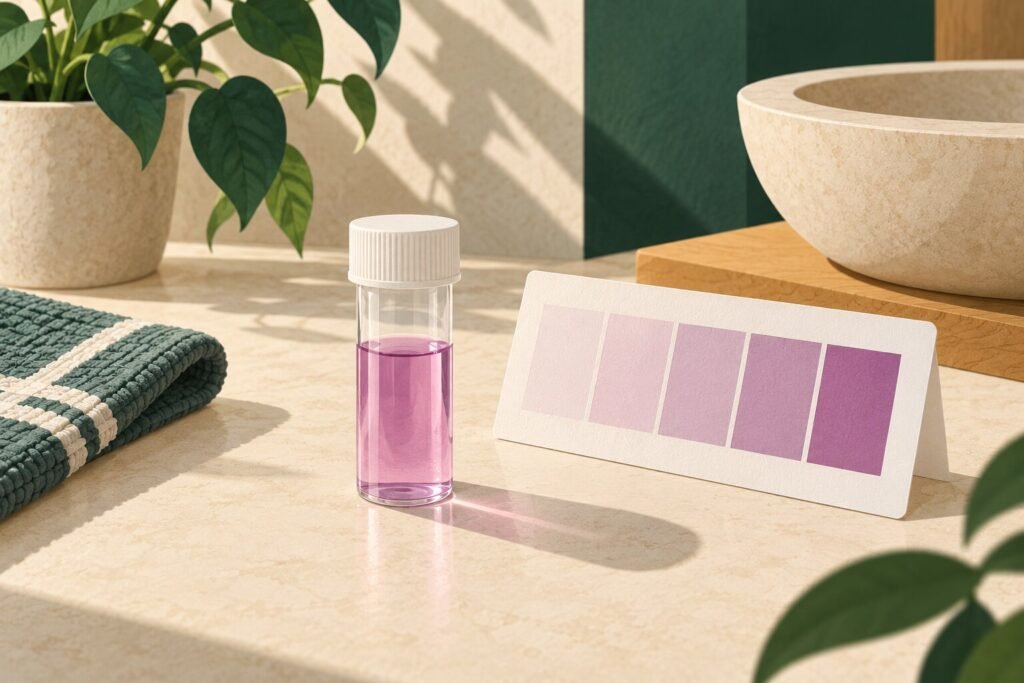
To check water hardness, use a hardness kit according to its instructions or ask a laboratory for the measurement. Choose the tap before you test. Incoming water tells you what a softener needs to handle, while a tap after treatment tells you about that outlet.
Read a strip at the specified time and match it to the supplied color scale. Don’t report extra decimal places that the kit can’t distinguish. For a lab sample, use the lab’s own collection instructions.
Decide which question you’re answering
Testing incoming hardness helps describe the supply a softener would need to handle. Testing a tap after a softener asks whether hardness is still reaching that location. Testing both can help you discuss system performance, provided the sample points and methods are comparable.
These are different questions. Label the samples clearly rather than recording two unexplained numbers. If you don’t know whether a tap is treated, check the plumbing arrangement first. An outside hose bib may bypass a softener, while a kitchen cold-water line may be deliberately left unsoftened.
Choose a screening test or a laboratory
A home kit can be suitable for an initial hardness screen. Follow its instructions for the sample amount, reading time, storage, and expiration date. If the result is close to a decision boundary, or the instructions are difficult to interpret, avoid pretending the reading is more precise than it is.
A certified laboratory can help when you want a documented result or need to investigate several water-quality questions together. Ask whether hardness is included in the panel you’re buying. A test package isn’t automatically comprehensive. The EPA directory links to state laboratory certification programs.
Hardness testing isn’t a substitute for the microbiological or chemical tests appropriate to a private well. Clear water and a low hardness result can’t rule out other hazards.
Keep a useful sample record
- Write down the water source. Public supply or private well.
- Identify the exact tap and whether it is before or after treatment.
- Record the date, method, result, and unit.
- Note any recent treatment maintenance or settings change.
- Use the laboratory’s collection instructions when submitting a sample.
Don’t improvise the collection process for a laboratory panel. The bottle, handling, and delivery requirements can differ by the substance being tested. Ask the lab before collecting, particularly if the same visit includes tests other than hardness.
Compare units before comparing results
Hardness may be reported as mg/L of calcium carbonate or as grains per US gallon. For a practical approximation, divide mg/L by 17.1 to get grains per gallon. Our hardness converter performs that conversion without making a system recommendation.
For example, 120 mg/L is approximately 7.02 grains per gallon. It is the same approximate hardness expressed differently. The conversion doesn’t make a screening strip more accurate or prove the water is safe.
When comparing a kit reading with a laboratory report, allow for the kit’s stated resolution and make sure the sample points match. A result after treatment shouldn’t be used as the incoming hardness in a sizing conversation.
Turn the result into better questions
If your goal is a softener quote, provide the incoming hardness result and ask the installer how they account for household demand, flow, and relevant water chemistry. Hardness alone isn’t enough to select a complete system.
If your goal is checking an existing softener, explain where and when the sample was taken, and describe any change in scale or cleaning performance. Ask about the equipment’s operating settings and maintenance instructions. Avoid adjusting regeneration settings solely because a regional map suggests a different number.
The hard-water guide explains the descriptive ranges. If you rely on a private well, use the well-testing guide to put hardness into a broader plan.
Sources
- USGS: Hardness of Water
- CDC: Guidelines for Testing Well Water
- EPA: Certified Laboratories for Drinking Water
- CDC: About Choosing Home Water Filters
This guide is AI-assisted and includes reference links. We haven’t tested your water or independently tested products. Follow local health advice and the instructions for your own equipment.
Read our editorial policy →