If flow drops just after a filter change, check the installed part number and the completed procedure against the system’s manual. Give support the timing and affected outlets. A slow stream doesn’t prove the new cartridge is exhausted, and flow isn’t the same measurement as pressure.
Use the manual’s safe service procedure or a qualified technician. Keep treatment for a health-related concern in the discussion. Bypassing that stage without understanding the water-use implications can create a separate problem.
Describe flow without calling it pressure
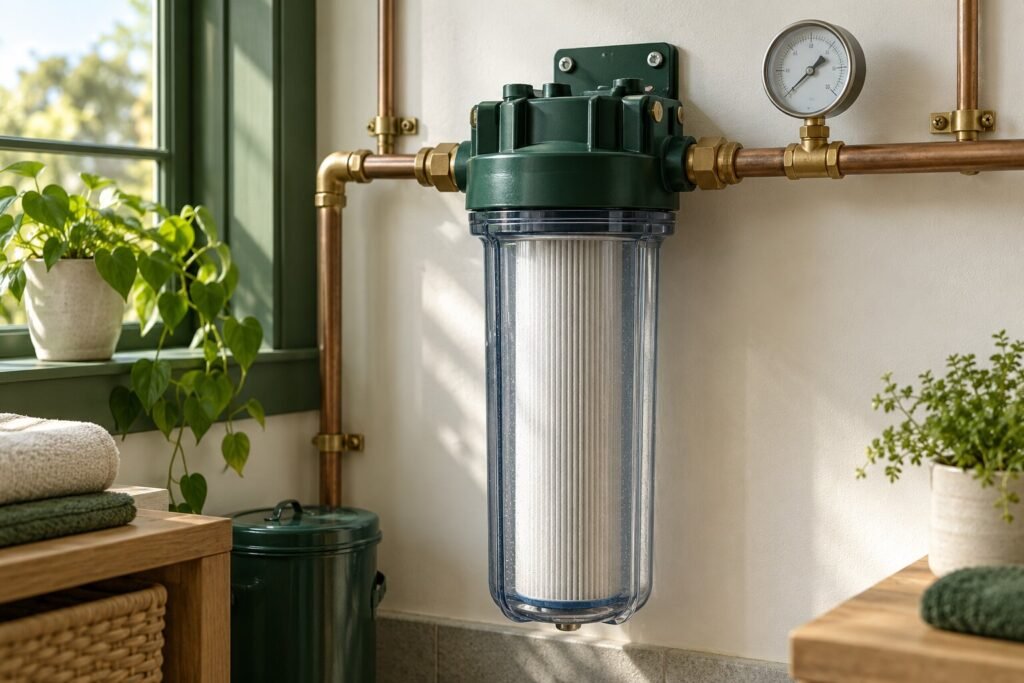
“Less water arrives in the glass” is an observation about delivery. It isn’t automatically a measured pressure result. If a professional needs measurements, ask how they should be obtained and interpreted. A gauge in an illustration can’t supply a reading for your plumbing.
Record whether the change affects one outlet, several treated outlets or other parts of the house. Note whether it began immediately after service and whether the service involved only a cartridge or additional work. These details make the question more specific than “the water pressure is bad.”
If the issue involves an RO system, retain its separate manual and service record. A tank-based or other RO arrangement has model-specific questions that shouldn’t be answered by instructions for a different cartridge housing.
Confirm the replacement identity
Write down the complete system model and the part installed. Compare the receipt, package and model documentation. A cartridge can resemble the previous component while having a different permitted use or configuration.
If the part is described as compatible, ask what supports that description. Don’t infer compatibility only from its length or color. Keep the exact identification available for support rather than discarding the packaging before the problem is understood.
| Record item | Why it helps |
|---|---|
| System and stage | Identifies which instructions apply |
| Installed part | Checks the actual replacement against the permitted component |
| Service date and tasks | Connects the observation with the work performed |
| Affected outlets | Distinguishes a local symptom from a broader pattern |
| Completed post-service checks | Shows which manual steps were followed |
| Other recent changes | Keeps unrelated plumbing or supply events visible |
Review the completed procedure with support
Use the actual manual and ask whether every relevant service and post-service step was completed. Pentair’s residential support material is an example of manufacturer-specific troubleshooting information, not a universal sequence for all systems.
If a step is uncertain, say so. A technician can assess an accurate description more effectively than a record that assumes the work must have been correct. Don’t fill an unknown step with a memory from servicing another device.
For unfamiliar equipment, call the manufacturer or qualified installer with the model number. Use that model’s valve, pressure-release, and flushing instructions rather than borrowing a procedure from another system.
Keep several possible explanations open
The timing can help prioritize questions, but it doesn’t prove cause. A change immediately after replacement may warrant a review of the part and procedure. A broader change may require the installer or supplier to examine other conditions. Ask what evidence would distinguish the possibilities.
Don’t keep replacing cartridges until the symptom happens to change. That approach can create a collection of unexplained parts purchases without identifying the underlying issue. A structured record makes each proposed action accountable to a question.
If a separate water-quality concern exists, keep it in the same support conversation. A troubleshooting action shouldn’t silently remove a treatment stage that was selected for a particular supported claim.
Record the resolution for the next change
After the issue is addressed, retain the actual finding and the work performed. Note the date and the model-specific checks completed. A statement such as “flow returned after the correct procedure was completed” is more useful than “new filter fixed it” if the latter omits the identified cause.
Use that record as context for later service, not as a guarantee that every future symptom has the same cause. If another pattern appears, gather new observations and compare them with the previous baseline.
Our housing-care guide explains the documentation to keep before a cartridge task. For an RO service record, use the stage-by-stage replacement guide.
Sources and product documentation
This guide is AI-assisted and includes reference links. We haven’t tested your water or independently tested products. Follow local health advice and the instructions for your own equipment.
Read our editorial policy →