Location: United States, with a Loudoun County, Virginia example. Official guidance checked 19 October 2026. Follow the latest local notice for your address.
A data center is proposed down the road, and the first neighborhood question is often whether there will be enough water for everyone. That is a reasonable planning question. A second question, whether something from the facility could reach household drinking water, needs a separate investigation.
Neither question can be answered by the size of the building alone. Start with the water supplier, the cooling arrangement and the discharge route. A home filter cannot increase a reservoir’s capacity or settle a dispute about who pays for a new water main.
Start with the source, not the property line
Ask whether the facility will use public drinking water, reclaimed water, its own wells or several sources. Find the supplier serving your address, too. Two nearby properties can have different service arrangements. Conversely, customers far apart can depend on the same source.
The Berkeley Lab data-center research program studies electricity and water demand across facilities. Its national research provides context, not a household diagnosis. A national annual estimate cannot tell you the facility’s summer peak demand, the condition of your service pipe or the concentration of a chemical in your glass.
For a proposed project, ask for the named planning document and the assumptions it uses. Separate an already operating connection from a future expansion. A request for capacity is not necessarily the volume currently being used.
Withdrawal, consumption and return are different entries
Withdrawal describes water taken from a source. Consumption describes the portion not returned for immediate reuse in that local water setting. Discharge describes a return stream. A useful project explanation should keep those entries distinct and state the period and units for each number.
Evaporative cooling can lose water to evaporation and remove some circulating water as blowdown. EPA’s cooling-tower guidance discusses the balance between these flows. Cooling designs differ, so don’t apply a single evaporation percentage to every data center or confuse a recirculating flow with new water demand.
A practical request is a one-page balance showing normal operations, peak conditions and the source of replacement water. Ask what changes during a drought and whether those conditions are enforceable or merely an aspiration in a presentation.
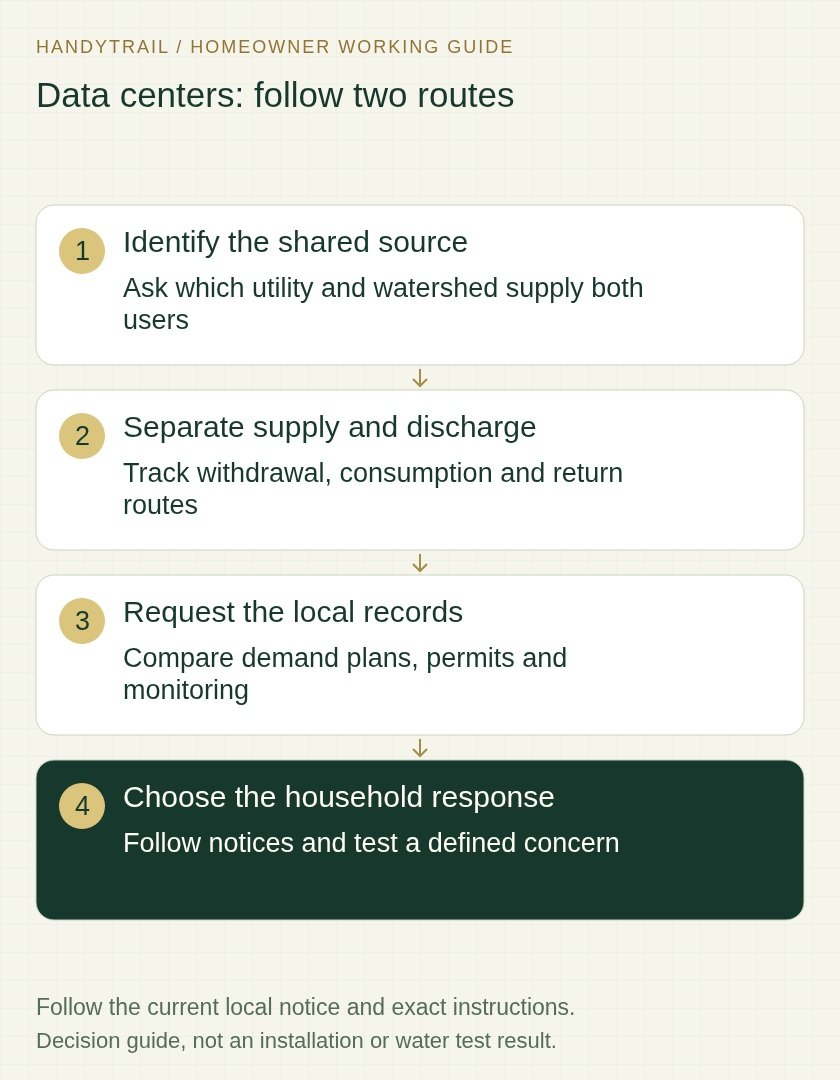
- Identify the shared source. Ask which utility and watershed supply both users
- Separate supply and discharge. Track withdrawal, consumption and return routes
- Request the local records. Compare demand plans, permits and monitoring
- Choose the household response. Follow notices and test a defined concern
A Virginia example shows why the water type matters
Loudoun Water’s reclaimed-water program supplies non-potable water for uses including industrial cooling. Its network was developed in part to serve the area’s data-center industry. This demonstrates why it is worth checking the actual connection rather than assuming every gallon is drinking water taken from homes.
It does not prove that every facility in Virginia uses reclaimed water, that supply is unlimited or that a particular project has been approved. Ask whether the site is connected now, whether another source supplies backup water and what capacity is available at the relevant time.
A homeowner can support efficient industrial use and still ask for clear local limits. Those positions fit together. The useful discussion concerns the source, timing, available capacity and responsibilities when conditions change.
Follow the discharge route separately
Cooling wastewater is not automatically sent into the pipe supplying your kitchen. Determine whether it enters a sanitary sewer, goes to a permitted surface-water discharge, is reused onsite or follows another documented route.
EPA’s permit explanation distinguishes discharges to regulated waters from discharges to municipal sanitary sewers. The responsible authority can explain which requirements apply to a named facility. Ask for the permit or sewer authorization, relevant monitoring and receiving location. A permit listing alone is not a household water-test result, and a complaint alone is not a finding of a violation.
If a headline names PFAS or another chemical, ask which substance was measured, where, when and by what method. Do not convert a general concern about an industrial category into a claim that the substance has been detected at your address.
| Question | Useful local evidence |
|---|---|
| Will demand compete with homes? | Supply planning, drought rules and peak-day demand |
| Where does cooling wastewater go? | Facility discharge route and applicable permit |
| Is my drinking water affected? | Utility monitoring, notices and targeted assessment |
| Should I buy treatment? | Identified contaminant and exact reduction claim |
Make a useful request to the utility
Give your service address and the project name. Ask whether the facility shares your drinking-water source, whether demand has been included in supply planning, and where you can read the current drought and capacity assumptions. Then ask who holds the wastewater records. The water supplier and the discharge regulator may be different organizations.
Keep the response with the document date. If a figure changes between a zoning meeting and a later engineering submission, record both versions and ask what changed. This is more useful than circulating a screenshot with no units or source.
For a community meeting, prioritize three unanswered questions instead of a long list of suspicions. For example, request peak-day demand, the drought response and the party responsible for infrastructure costs. Ask for the location of the written answer so neighbors can check the same record.
Keep household treatment tied to household evidence
Check current supplier notices before making any treatment decision. If there is a specific concern, discuss the appropriate sampling point and laboratory panel with the utility, health department or qualified water professional. A general TDS reading cannot identify the source of dissolved material or establish whether an industrial chemical is present.
Treatment proposals should identify the contaminant, the measured concentration or applicable concern, the exact reduction claim and the maintenance requirements. Buying a larger filter because a large building is nearby skips the evidence needed to choose it. Start with the records, then decide whether any household action is actually supported.
Frequently asked questions
Does a nearby data center prove that tap water is contaminated?
No. Distance alone does not establish a shared water source, a discharge pathway or a measured problem at your tap. Ask the utility and regulator for the relevant records.
Does reclaimed cooling water become household drinking water?
A non-potable reclaimed distribution system is a separate use. A drinking-water reuse project is a different treatment and regulatory arrangement. Ask which system the facility actually uses.
Related practical guides
Continue with these related explanations. Follow current local instructions for any active notice or investigation.