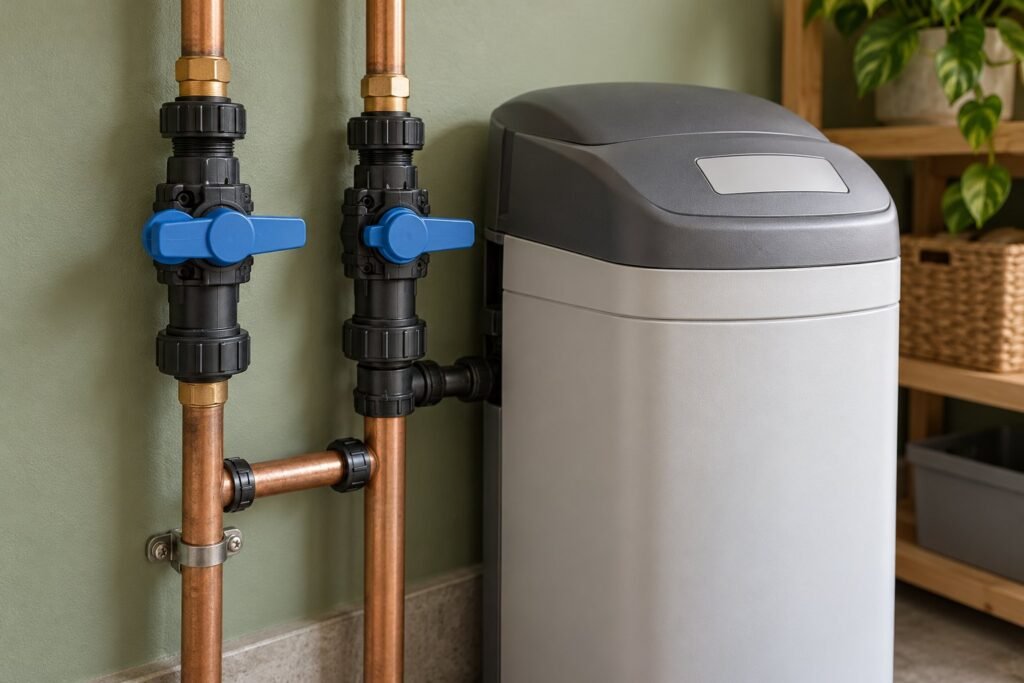
A water softener's bypass routes water around the softener rather than through its treatment path. It can let the household keep a water supply while the softener is taken out of that path for appropriate service. The position labels and operating procedure depend on the exact valve arrangement.
If water seems hard after maintenance, a documented bypass state is one thing to check with the service provider. It isn't proof that a valve is faulty or that changing a handle will solve the problem. Start with the model, labels and instructions before touching unfamiliar plumbing.
Service and bypass describe different paths
In the usual service arrangement, the supply passes through the softener's intended treatment path before reaching the fixtures connected to it. In bypass, water is routed around that equipment. A fixture can therefore keep running even though its water is no longer passing through the softener.
The Whirlpool WHES18 owner's manual explains that bypass valves allow water to the softener to be turned off for maintenance while water remains in the household pipes. Its single-valve drawing labels the pull-out position as service and the push-in position as bypass. Those labels describe the pictured assembly only.
Don't apply that handle direction to a different model. Some installations use a different integrated valve, and others have a separate three-valve arrangement. A similar tank or brand name doesn't establish that the control works the same way.
The named manufacturer is a documentation example, not a paid promotion or a recommendation to buy that unit. Follow the instructions for your actual equipment and ask a qualified service provider when the installed arrangement doesn't clearly match them.
A running faucet doesn't confirm treatment
A softener bypass is designed to change the water's route. Continued flow at a faucet may be entirely consistent with bypass operation. It doesn't establish that the softener is in service or that the water has the expected hardness.
Nor does the word bypass establish drinking-water safety. Softening is not a general microbial or chemical safety assessment. Keep laboratory results, any water advisory and local health instructions separate from observations about the valve state.
Some fixtures may already receive unsoftened water by design. The WHES18 manual includes a typical installation drawing with an outside-faucet branch before the softener. Your own layout may differ. Check which fixture supplied the sample before using its result to evaluate softener performance.
Identify the installed arrangement
Recover the full softener model and the matching bypass or installation documentation. Look at accessible labels from a safe, dry position. Save a photograph of the assembly without removing covers, fittings or retaining clips.
Ask whether the installation uses the manufacturer's integrated assembly or a separately designed arrangement. If separate valves are involved, have the installer identify their purposes in the service record. A row of similar handles is not enough information to make a reliable operating decision.
Missing labels and undocumented alterations deserve clarification. Don't borrow a three-valve sequence from an unrelated video, or identify inlet and outlet solely from a photograph. The provider should connect the actual pipe layout to the correct instructions.
Keep bypass separate from a main shutoff
Bypassing a softener doesn't necessarily stop water throughout the house. It can preserve the supply around that equipment. It also isn't a universal way to isolate every leaking fitting near the installation.
Find the home's shutoff information separately and keep it in the household record. If there is an active leak, a damaged assembly or water near electrical equipment, seek appropriate professional help. Don't start turning unfamiliar valves to discover which one might stop the water.
Even when bypass is part of a service procedure, the manual may require other steps before opening equipment. Changing the route does not by itself prove that every component is depressurized or electrically safe. Avoid disassembly and use the exact service procedure or a qualified technician.
What to record after a service visit
| Detail | Useful record | What it does not prove |
|---|---|---|
| Equipment identity | Softener model and bypass arrangement | That another model uses the same handle direction |
| Valve state | Provider-confirmed service or bypass state and date | That a visible handle alone verifies treatment |
| Work performed | Reason for service and actual actions | That all faults were diagnosed from one symptom |
| Sample location | Fixture and whether it is on the treated path | That every household tap receives the same water |
| Follow-up plan | Agreed checks and responsible person | That salt use or a running faucet confirms performance |
A short written note is easier to use later than a memory that someone "turned the water back on." Ask whether the equipment was returned to its intended operating arrangement and whether any part remains temporarily out of service.
If the service provider leaves it bypassed intentionally, ask why and what needs to happen before return to service. Keep the expected follow-up and any use restrictions in writing. Don't restore a treatment path yourself merely because the original reason wasn't written on the tank.
Use an appropriate hardness comparison
If the question is whether softening is working after service, confirm the intended sample locations and relevant test method. Keep untreated and treated results separate, with their units and dates. The hardness-testing guide explains why the sample point matters.
For a clearly hypothetical example, an outside fixture might be on an untreated branch while a kitchen fixture is on the softened path. A hardness result from the outside fixture would then describe that branch, not necessarily a failure of the softener. Your plumbing layout must establish the distinction before interpreting the two results.
A result taken during a known bypass period also needs that context. Don't compare it with an older treated sample as though both were collected under the same conditions. Ask the provider what observations or repeat tests make sense after the actual operating arrangement has been restored.
If salt is being consumed while hardness remains, use the separate troubleshooting guide to assemble evidence. It considers untreated and treated measurements without assuming one visible component is the cause.
Don't confuse bypass with regeneration
Bypass changes the supply route around equipment. Regeneration is part of the softener's operating cycle. They are different concepts, and a control-panel message does not necessarily document an external valve position.
Use the regeneration guide for the cycle discussion. Avoid starting repeated manual regenerations to compensate for an unexplained valve arrangement. That doesn't establish the correct route or resolve a missing installation record.
If the display, service paperwork and visible labels seem inconsistent, send those details to the provider. Preserve exactly what the display says rather than translating it into a diagnosis. The model manual and the actual assembly need to agree before an operating instruction is meaningful.
Make the next visit easier
Keep a photograph, model identity and the provider's explanation in your water-equipment record. Label any drawing with the date and who supplied it. A generic illustration online should never take the place of a record of your own pipe arrangement.
Ask the provider to identify which fixtures are intended to receive softened water and what checks are appropriate after service. If equipment changes later, update that record. Old valve labels and assumptions can become misleading after an installation is altered.
You don't need to memorize every internal part to keep a useful household record. You need a clearly identified system, the correct instructions and a documented reason for any temporary bypass. That gives the next service conversation a much better starting point than guessing from a handle's color.