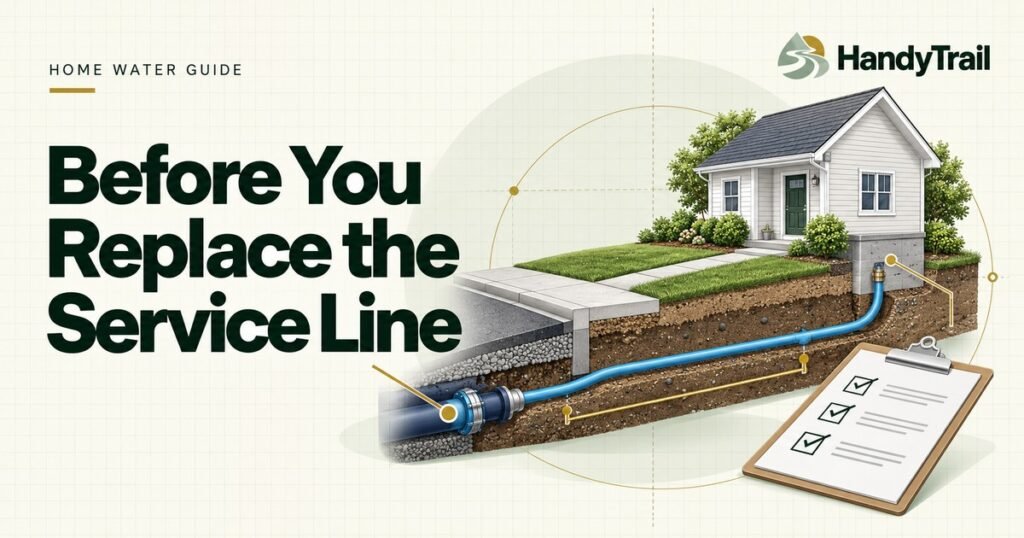
A water service-line replacement quote should describe the full job between the agreed connection points, not just a price for a length of pipe. Before comparing proposals, establish which sections are involved, who is responsible for them and what your utility requires. The ownership boundary and approved work process can vary by location.
This guide helps you ask for a clear proposal. It does not tell you to excavate a line, operate a utility valve or choose a material without local approval. If a utility has already identified a lead line or issued specific instructions, keep those instructions with the project documents from the beginning.
Confirm which line the proposal describes
A service line supplies the property from its outside connection. Indoor distribution carries water onward through the building. A proposal to replace one is not automatically a proposal to repipe the other. Ask the contractor to identify the start and end points in words or on a simple site sketch.
Also ask what is known about the existing material and what remains unverified. The EPA's Protect Your Tap guidance describes service-line identification and utility involvement. A visible indoor section alone may not establish the material along the entire buried route.
Keep the utility's inventory or correspondence, the contractor's observations and any earlier invoices as separate records. If they disagree, ask which section each record refers to. Don't turn an uncertain buried section into a confirmed material just to complete the quote form.
Ask the utility about its process
Contact the utility before treating a contractor's proposed material or connection method as settled. Ask about ownership, authorization, approved materials, connection work, inspection and any applicable replacement program. Request the current written requirements when they are available.
A program described on another city's website may not apply to your address. Likewise, a neighbor's recent project may have different conditions or eligibility. Use those examples to form questions, not to assume reimbursement, free replacement or a particular division of costs.
If the property is served by a private well, identify the actual supply route and responsible parties instead of using a municipal service-line process by default. Pump, well and building connections can involve their own requirements. Make sure the proposal matches the supply the house actually has.
Describe access and restoration
The route can affect far more than the pipe price. Ask whether the proposal assumes excavation, a trenchless method or another approach, and what site information supports that choice. Soil, route, access and nearby structures need a site-specific assessment.
Write down what restoration is included. A quote may address the pipe and leave paving, landscaping, interior patching or another finish to a separate contractor. Don't assume the word complete covers those items. Ask what the property will look like after the work and who handles each remaining task.
Also ask how underground utility locating and required approvals will be arranged. This is not a homeowner excavation checklist. The goal is to identify the provider's planned process and responsibilities before work starts, including how a route change or unexpected obstruction would be handled.
Compare the written scope
| Proposal item | What a useful answer identifies |
|---|---|
| Connection points | Which section is being replaced and where work begins and ends |
| Existing material | Confirmed sections, uncertain sections and the supporting records |
| New pipe and fittings | Exact specification and the applicable utility or local acceptance |
| Installation approach | Site assumptions, access and the proposed method |
| Approvals and inspection | Responsible party and the required process |
| Restoration | Included surfaces, finishes and excluded work |
| Supply interruption | How the household will be notified and what arrangements apply |
| Completion record | Inspection, material record and any required follow-up instructions |
Two quotes with different endpoints or restoration scopes are not directly comparable. Put those differences above the totals. A higher price may include work missing from the other proposal, while neither proposal should be accepted merely because its description is longer.
Plan the household's water interruption
Ask how the planned interruption will be communicated and whether the schedule may change. Explain any household needs that depend on water, including treatment equipment that requires a particular shutdown or restart procedure. The installer should know which equipment is connected before assuming a routine interruption covers everything.
Keep the exact filter, softener or other equipment manuals available. A general service-line instruction is not automatically the manufacturer's restart instruction for every device. Ask who will confirm the relevant arrangements and who answers a problem after the work is completed.
The plan should also identify what to do if the interruption lasts longer than expected. Avoid promises that a project will always finish in a particular number of hours unless that commitment is actually part of the provider's agreement. A practical contingency is more useful than an optimistic estimate presented as a guarantee.
Separate project completion from water follow-up
Ask which flushing, testing or other follow-up instructions apply to this particular project. The utility or appropriate authority should explain them when a service-line change creates a specific concern. Don't combine several online sampling methods into a procedure of your own.
For lead-related work, see our sampling after service-line work guide. This article addresses the proposal and responsibilities. The sampling guide addresses the separate question of how to obtain information that answers the intended water-quality question.
A completed invoice is evidence that billed work was recorded. It is not automatically a water-quality result or proof that every section of plumbing was replaced. Keep the inspection and any water follow-up documents beside the invoice so their different purposes remain clear.
Make the cost comparison transparent
Ask which fees, taxes, permits, connection charges and restoration items are included. If the provider offers optional work, list it separately. An unknown cost should remain an unanswered question rather than being entered as zero in your budget.
Use the quote comparison tool for entered costs when the same period and scope make sense. The arithmetic does not approve a buried material or compare contractor competence. Use the pipe climate guide to organize exposure questions, then return to the utility's actual requirements.
Send the unanswered questions back in one message
Before accepting a proposal, collect the gaps into a short written request. For example, “Please confirm the two connection points, the specified pipe and fittings, who arranges utility approval, and which surfaces you will restore. Please also identify any charge that is still an allowance rather than a confirmed amount.” This is an example of a clarification request, not wording from an actual contractor.
Ask for the reply to become part of the updated proposal. An email that explains an exclusion is useful, but another person reviewing only the original quote could miss it. The final documents should agree about what is included, what remains uncertain and how a change will be approved.
If two providers answer differently, separate a difference in scope from a difference in price. One may include driveway restoration while the other excludes it. Request the missing amount or responsibility before describing either total as the complete project cost.
Save the dated revision you accept. Keep earlier versions separately so a replaced estimate is not mistaken for the current agreement. Clear paperwork cannot remove every site uncertainty, but it makes the next conversation about a changed condition more specific.
Keep a handover record
Request a final record of the installed material, connection points and any changed route. Save the inspection information, completion date, responsible company and follow-up instructions. A sketch or labelled photo can be valuable when future work needs to locate or identify the line.
Mark remaining uncertainties rather than quietly removing them from the record. A project can replace the agreed section while leaving other plumbing unchanged. Clear boundaries help the next contractor understand the house and keep a future quotation from starting with the same unanswered questions.