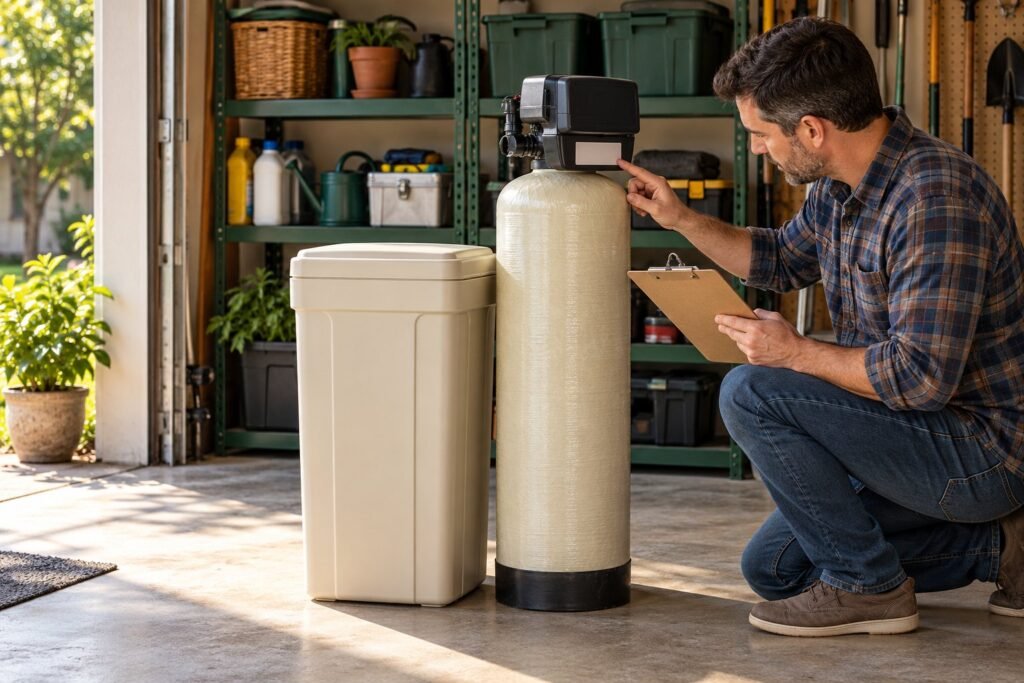
A used water softener can have a low asking price and still be expensive to put into service. The useful question is whether this particular unit fits your water, your household demand and an installation you can support. Unknown equipment history belongs in the budget, not behind a hopeful guess.
Before paying, recover the model number, current manual and service history. Ask a qualified installer about the proposed location and connection work. A softener from a nearby house isn't automatically a match just because the previous owner liked it.
Identify what is actually being sold
A listing may show a resin tank and control head but omit the brine tank, bypass assembly, power supply, drain parts or other model-specific components. Ask for photographs of the equipment labels and a written list of what comes with the sale. Don't infer completeness from a tidy garage photo.
The exact model opens the door to useful questions. You can find the intended operating range, supported parts and instructions. Without it, a seller's grain-capacity claim is difficult to evaluate and a replacement control component may be hard to identify.
Keep personal contact information off any public photograph you share. A local service provider needs the equipment identity and condition, not a screenshot of the seller's entire conversation. If the label is unreadable, treat that as unresolved before committing money.
Match the unit to incoming water
Find a relevant untreated-water hardness result, its units and the sample location. If the home uses a private well, ask the laboratory or local authority what other tests are appropriate. A softener selection should not stand in for a broader water-quality assessment.
A hardness result from a treated tap can describe softener performance, but it doesn't establish the incoming value used in selection. A regional map or the seller's old setting is also not a measurement of your new supply. Keep those differences visible when discussing the unit with an installer.
Softening and filtration solve different problems. A salt-using softener should not be presented as a general solution for microbes or every dissolved contaminant. If the proposed treatment plan requires other equipment, include that cost and space before judging the used unit a bargain.
Capacity and flow are separate checks
The largest grain number in an advertisement is not the only useful specification. A model can have different rated capacities at different salt doses. Its service-flow information concerns the water demand it is intended to handle under stated conditions.
The Whirlpool WHES18 manual is one example of how manufacturers document these distinctions. Its specification table lists capacities at different salt doses, and its notes distinguish intermittent flow from service flow. Those figures belong to that model, not to every used softener with a similar tank.
This manufacturer is mentioned as a paperwork example, not a paid promotion or a tested recommendation. Use the manual for the unit under consideration. Ask the installer to explain how the proposed equipment fits your measured hardness and likely simultaneous water use.
A household with several fixtures running together may have a different requirement from a household using one fixture at a time. That doesn't create a universal sizing formula here. It creates a reason to discuss capacity and flow separately before moving a heavy cylinder home.
Ask about the service history
Request installation and service dates, known repairs, periods out of use and any history of freezing, flooding or leaks. Ask why it is being sold. Keep the seller's answer as reported history rather than as an independently verified inspection.
An unknown date should stay unknown. A clean outer shell doesn't tell you the condition of resin, seals or the internal control parts. Salt remaining in a tank is not a performance test either. If a technician cannot meaningfully assess the unit before purchase, decide how much uncertainty you're willing to accept.
Look from a safe position for damaged fittings, visible cracks or missing covers. Do not open a pressurized vessel, power questionable equipment or perform an improvised regeneration test. Transport and storage also need the manufacturer's instructions, especially where retained water, weight or freezing conditions are involved.
Make a before-purchase worksheet
| Question | Evidence to keep | Unresolved issue |
|---|---|---|
| Which model is it? | Clear label and matching manual | Unreadable label or mixed components |
| Is the unit complete? | Included-parts list and photos | Required connections or power supply missing |
| Does it suit the supply? | Untreated result and installer assessment | Selection based only on seller settings |
| Can it be serviced? | Parts identification and local support | Discontinued parts without a confirmed alternative |
| What history is known? | Reported dates, repairs and storage | Unknown condition, freezing or previous damage |
| What will installation involve? | Written scope and local requirements | Asking price excludes most of the work |
The worksheet doesn't certify the equipment. It separates known facts from the things a professional still needs to resolve. Bring it to the installation discussion instead of trying to remember every detail from a marketplace message.
Price the installed arrangement
The asking price is one line in a larger budget. Add collection or delivery, professional assessment, missing approved parts, connection work, any required drain arrangement and initial service. Include the cost of dealing with equipment that proves unsuitable.
For a hypothetical budgeting example, compare a used unit at $200 with a different option at $800. If the used route needs $450 of installation and missing parts, its known subtotal becomes $650 before any unresolved repair. Those invented figures demonstrate budgeting only. They are not market prices or a quote for your home.
Ask for a written scope with the same inclusions when comparing alternatives. A number for an equipment-only sale cannot be compared fairly with an installed quote that includes permits, commissioning or removal. Use the quote-comparison guide to keep the two offers aligned.
Check support and warranty without assuming
Find out whether the manufacturer still supports the exact model and whether the proposed installer will work on customer-supplied used equipment. Ask what the service provider will warrant about its own work. These are separate questions from any remaining manufacturer warranty.
Warranty terms differ by product and transaction. Don't assume an old receipt transfers coverage to a new owner, or that a seller's phrase like "still under warranty" settles it. Ask the manufacturer for an answer that applies to this serial number and sale arrangement.
Support availability matters beyond the first week. A low price becomes less attractive if the correct valve part, controller or service documentation cannot be obtained. Confirm current support rather than guessing that a popular brand will always stock every old component.
Arrange installation before collection
The proposed location needs suitable access and an appropriate connection plan. Drain requirements and local rules can affect whether the unit can be installed there. Read the softener drain-line questions and ask the installer to resolve the layout before purchase.
Keep the written plan with the equipment identity. If the seller changes what is included, revisit the scope. Don't adapt an undocumented connection or reuse an unknown electrical supply merely to avoid losing the deal.
Keep the first service record honest
If you proceed, record the actual installation date, installer, model, approved settings and agreed checks. Keep inherited history separate from work you can document. Use the equipment record and keep the professional's invoices and any laboratory reports alongside it.
After installation, follow the agreed verification plan for the exact equipment and supply. Salt use alone doesn't establish that the water is being softened as intended. A used unit earns its place by fitting the documented plan, not by having been inexpensive to buy.