Location: Northern Ireland — road, property and drainage responsibilities. Official guidance checked 19 October 2026. Follow the latest local notice for your address.
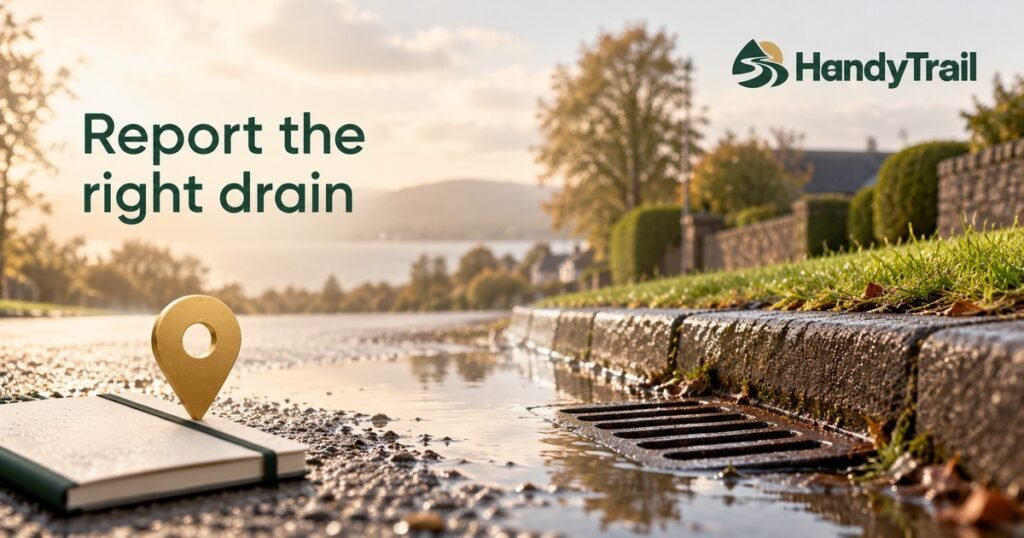
Roadside ponding, a blocked gully and a sewer overflow can all be described casually as “a drain problem.” In Northern Ireland, the reporting route depends on what is happening and where. Giving the correct observation and location is more useful than guessing which pipe failed.
Do not enter floodwater, lift covers or work in traffic to establish a cause. Moving water, hidden openings and contamination can make an apparently shallow area unsafe. An immediate danger to life needs the emergency services, not a routine online fault report.
Separate a current flood from a maintenance fault
nidirect’s road-drainage guidance distinguishes blocked gullies and roadside-drainage reports from current flooding affecting road users or entering property from the road. For that current-flooding situation, it directs callers to the Flooding Incident Line on 0300 2000 100.
Use the current official guidance when reporting. A maintenance form completed after a storm and an incident requiring a prompt response serve different purposes. Do not wait to complete a detailed photograph collection if people are at risk.
Record the nearest address, direction of travel or side of the road and useful visible landmarks. Say whether the water is collecting, flowing from a visible point or moving toward a property. If the source is unknown, state that uncertainty.
Keep sewer and supply concerns distinct
The same nidirect guidance directs overflowing public-sewer and burst-main concerns to NI Water. A public water main and a sewer have different functions. The appearance of water alone does not prove which route is involved.
Describe any visible escape point, timing and related household symptoms already observed. Do not deliberately taste water or enter a contaminated area to classify it. A clear-looking flow is not permission to use it or evidence that an area is safe.
For an indoor backup, stop the affected water use and contact the appropriate service or building manager. Repeated flushing and appliance cycles can make the event worse. Tell the professional about drain chemicals already used before any work begins.
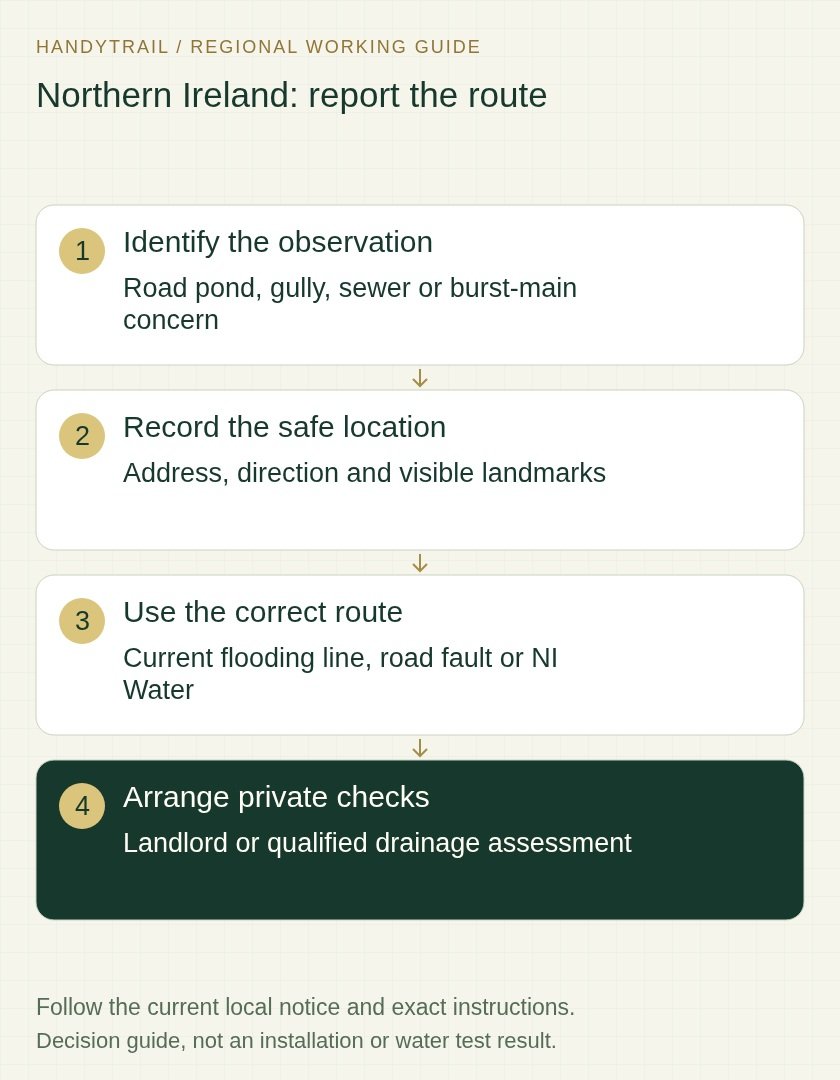
- Identify the observation. Road pond, gully, sewer or burst-main concern
- Record the safe location. Address, direction and visible landmarks
- Use the correct route. Current flooding line, road fault or NI Water
- Arrange private checks. Landlord or qualified drainage assessment
Prepare a location record that someone else can use
A wide photograph from safe ground can show an address or road feature alongside the incident. Avoid close-ups without landmarks. Keep the original date and time, and do not edit the image to imply a depth or source that was not established.
If several people report the event, share the reference number and confirmed observations. Repeated accounts with conflicting locations can be harder to reconcile. Do not substitute a social-media discussion for the official report.
County descriptions such as Antrim, Down or Fermanagh can provide geographical context, but the exact location and responsible asset still matter. They are not a diagnosis or a guarantee that a local council owns every drain nearby.
| NI observation | Official starting point |
|---|---|
| Blocked road gully or roadside drainage | nidirect road-drainage fault guidance |
| Current road flooding affecting users or property | Flooding Incident Line, as directed by nidirect |
| Overflowing public sewer or burst main | NI Water |
| Suspected wrong household drain connection | Owner or landlord and appropriate plumber |
Investigate household connections as a separate task
nidirect’s household-drain guide distinguishes foul-water and rainwater drainage, while recognising that some properties have combined arrangements. Do not identify the buried layout solely from the building’s age or a nearby grate.
A washing machine or sink connected to an inappropriate rainwater route can create a pollution problem. Conversely, wrongly connected roof water can add a load to a foul-water route. A qualified assessment should establish the actual connections before alterations are made.
In a rented property, tell the landlord about a suspected misconnection. Do not commission a change to shared or concealed drainage without the necessary authority. A contractor should explain what was traced and what remains unconfirmed.
Do not clear a public route by improvising
Lifting a road grate, entering a chamber or using tools in a public drain is not part of a household reporting checklist. Neither is pouring cleaners, fats or other waste into a road gully. Keep drainage safeguards and working access with the appropriate service.
For private work, request a clear scope covering diagnosis, access, proposed clearing or repair and any separate survey. A camera inspection and an ordinary clearance are not identical services. Ask what evidence of the finding will be retained.
If floodwater has affected a home, use nidirect’s flood-response advice and the appropriate local support. Protect people before gathering documents. A drain repair and the cleanup of contaminated building material can require different help.
Keep the completed response tied to the location
Save the incident reference, time, safe photos, official response and any private contractor’s report. Ask whether another visit, inspection or owner action remains outstanding. A report marked closed does not necessarily mean every private-property issue has been assessed.
After the immediate event, compare any follow-up finding with the original observation. If the location was corrected or the suspected route changed, retain the clarification rather than repeating the original guess as fact.
A good reporting habit is simple: describe the water and location, choose the current official route and keep household connections as a separate investigation. It helps the right service respond without asking residents to perform an unsafe inspection of the road or sewer network.
Frequently asked questions
Should I report every street puddle as a burst main?
No. Describe what you observed and use the relevant official reporting guidance; do not invent the cause.
Can a washing machine drain into a rainwater gully?
Not as a general rule. Foul water and rainwater have different routes; ask a qualified provider to assess the actual connections.
Related practical guides
For background recordkeeping and equipment questions, these guides can help. The local authority and supplier instructions above govern the regional response.