Location: Ontario — Toronto. Official guidance checked 19 October 2026. Follow the latest local notice for your address.
A sump-pump battery backup needs more than a battery beside the pit. It needs a compatible pumping arrangement, a charger that maintains the battery, controls that start the right equipment and somewhere for the water to go. Losing mains electricity is only one way a basement pumping system can fail.
For a Toronto home, start with a dry-weather assessment before buying equipment. If the basement is already flooding, stay out of water near electrical equipment and get appropriate help. This planning guide does not provide wiring, discharge sizing or an improvised outage test.
Decide which failure the backup should cover
A primary pump can lose power, develop a mechanical fault or fail to start because of a control problem. The discharge route can also become restricted. A device that addresses one failure is not automatically independent of the others.
Ask whether the proposal powers the existing pump or includes a separate backup pump. Get the exact models and a plain explanation of what continues to operate when a particular component fails. Do not assume the word “backup” means every part is duplicated.
Write a scenario beside the equipment list. For example, “normal power fails while water is entering” is a different question from “the primary float cannot move.” The installer should explain which scenario the selected arrangement can address and which remains outside its job.
Read runtime claims with their conditions
A quoted runtime needs context. Pump load, cycling, battery condition and the test arrangement can all affect the result. A broad advertisement showing hours of operation does not establish how long your installed system will manage a particular storm.
Ask for the stated duty conditions and the supported battery and charger. Keep a continuous-run claim separate from an intermittent pumping example. Do not multiply a brochure’s maximum runtime by a second optimistic assumption about how rarely the pump will start.
An illustrative comparison sheet might show one proposal quoting runtime without stating the load and another documenting the pump and test cycle. The second is easier to question intelligently, but it is still not a guarantee about the next weather event. Ask how real installation conditions were assessed.
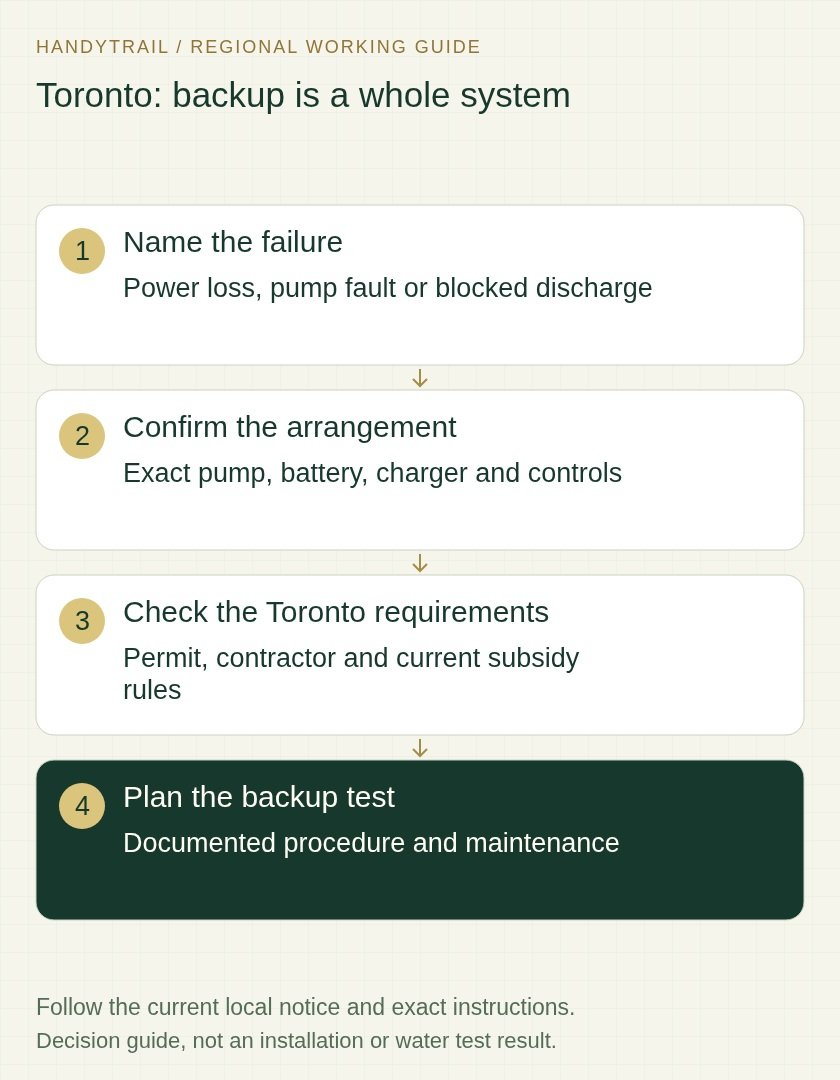
- Name the failure. Power loss, pump fault or blocked discharge
- Confirm the arrangement. Exact pump, battery, charger and controls
- Check the Toronto requirements. Permit, contractor and current subsidy rules
- Plan the backup test. Documented procedure and maintenance
Check the discharge and controls as part of the same job
Backup power cannot clear a blocked route or correct an unsuitable outlet. Ask the installer to assess the entire path, including the destination, changes in height, any required valves and access for maintenance. Do not alter connections to a municipal sewer or neighbouring property yourself.
The City’s basement-flooding prevention guidance places pumping within a wider property-drainage plan. A sump pump, backwater valve and downspout arrangement do different jobs. Buying one component should not obscure an unresolved source of water entry.
Ask how alarms behave if mains power or household internet fails. An alert that cannot reach anyone is not the same thing as a monitored response. Agree who receives it and what they should do, particularly if the property is empty.
Separate Toronto approvals from financial assistance
Toronto’s Basement Flooding Protection Subsidy Program identifies eligible work and application conditions, including arrangements involving sump pumps and battery backup. Check the current requirements for the property and the proposed work before relying on a contribution.
A program listing does not approve an individual design or establish that an application will be accepted. Ask which permits, contractor qualifications, inspections and records apply. Keep the actual eligibility decision separate from the contractor’s sales estimate.
Do not use an old subsidy amount as a purchase budget. Programs can change and a property may have a relevant application history. Confirm the current position through the City and keep receipts and completion records in the form the program requires.
| Backup question | What a complete proposal identifies |
|---|---|
| Pump performance | Supported flow at the actual discharge head |
| Battery and charger | Compatible equipment and stated test conditions |
| Water route | Discharge destination, valves and service access |
| Completion | Required approval and demonstrated operating check |
Make the maintenance plan easy to follow
Request the exact manufacturer’s test and maintenance instructions for the complete system. Battery chemistry and controls differ, so there is no universal replacement schedule or cleaning procedure in this article. Record the installed models, commissioning date and next specified check.
Do not disconnect a live assembly, bridge a control or improvise a power-failure experiment. Ask the installer to demonstrate the supported procedure from a safe, dry position. A successful alarm sound alone is not evidence that water was pumped through the complete discharge route.
Keep observations from ordinary service. A changed cycle pattern, warning indication or visible damage deserves the documented response. Replacing the battery without assessing another fault may leave the original problem unresolved.
Close the installation with a written handoff
Before the job is complete, ask for the equipment list, assessed water route, required approval records and commissioning result. Include what the household should do if the backup alarms or cannot meet the incoming load.
Retain any private-property restoration exclusions separately. If an existing arrangement cannot be assessed because access is blocked, make that limitation explicit rather than treating the quotation as a complete inspection.
A good purchase leaves you able to name the failure being covered and the conditions under which the backup was checked. That is more useful than an isolated battery specification or a promise that one accessory prevents every type of basement flooding.
Frequently asked questions
Does a battery guarantee a dry basement?
No. A backup needs a suitable pump, working controls and a usable discharge route. Battery condition and event duration also matter.
Does a Toronto subsidy approve my design?
No. Eligibility, permits, installation suitability and ongoing maintenance are separate questions.
Related practical guides
For background recordkeeping and equipment questions, these guides can help. The local authority and supplier instructions above govern the regional response.