Location: UK — sealed heating systems, England examples. Official guidance checked 19 October 2026. Follow the latest local notice for your address.
A falling boiler pressure reading and a weak kitchen tap are different observations. On a sealed central-heating system, the displayed pressure concerns the heating circuit. It should not be treated automatically as a measurement of the incoming drinking-water supply.
Start by identifying the appliance and system arrangement. An open-vented installation, a sealed system and a different appliance may need different guidance. This article is a record-and-service guide, not a universal filling procedure or an instruction to open a boiler case.
Identify the gauge and the manual
Copy the boiler model from an accessible label or paperwork and find its current user instructions. Record whether the reading is on a dial, an electronic display or a separate system gauge. Do not assume every symbol or coloured section means the same thing across models.
A supplier’s public water-pressure advice can help with a household supply issue, but it does not diagnose the sealed heating circuit. Conversely, a normal tap does not establish that the heating system has retained the right amount of water or is functioning correctly.
If you are a tenant, give the landlord or managing agent the model, fault message and observation rather than attempting service work. In a shared building, first confirm which equipment serves the property and who controls it.
Compare readings under known conditions
Write down the time and whether the heating was cool, warming or had been operating. Pressure can change with operating conditions. Comparing one cold-system reading with a warm-system reading without context can make an ordinary change look like a sudden fault.
Keep the displayed number and unit as shown. If the display is unreadable or behaves unexpectedly, record that limitation instead of selecting a number that seems plausible. A photo from a safe, accessible position can preserve a fault message for the engineer.
Do not deliberately run an appliance in a fault state to gather more readings. If the manual says to stop, follow that instruction. Water near electrical equipment, gas concerns or another unsafe condition takes priority over completing a pressure log.
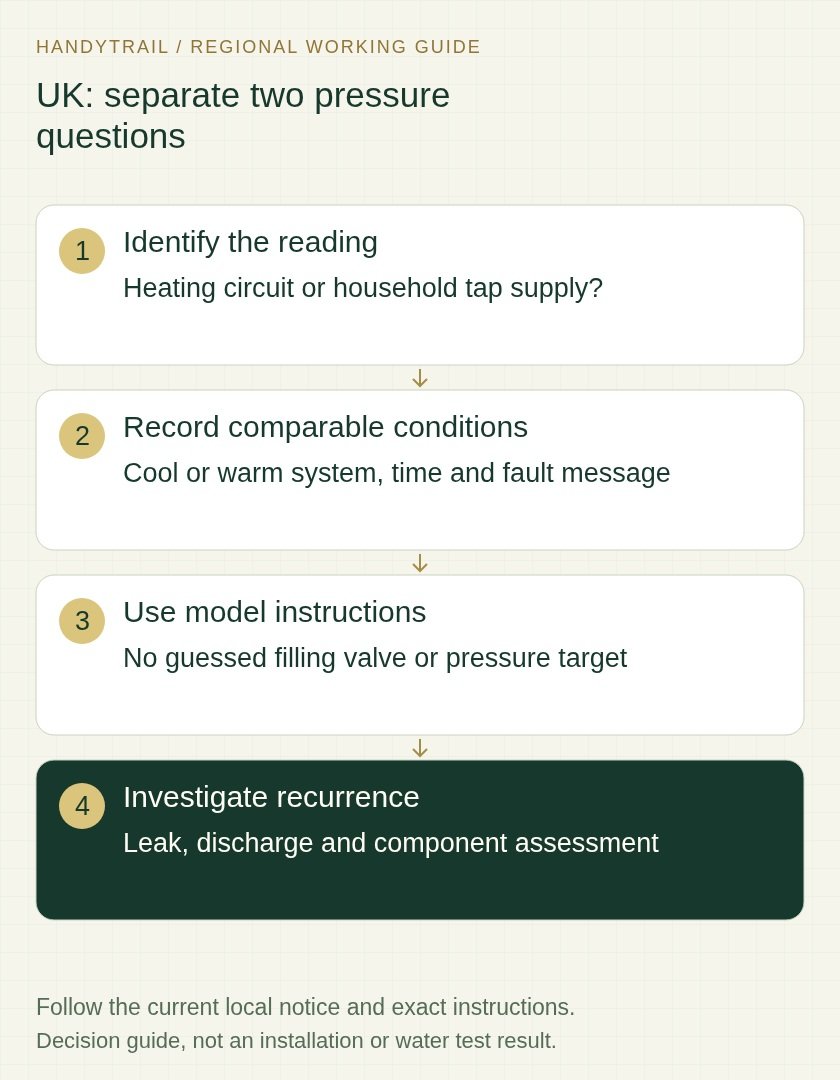
- Identify the reading. Heating circuit or household tap supply?
- Record comparable conditions. Cool or warm system, time and fault message
- Use model instructions. No guessed filling valve or pressure target
- Investigate recurrence. Leak, discharge and component assessment
Do not guess at a filling control
A filling arrangement needs the actual model and installation identified. Similar-looking valves may serve different purposes. This guide gives no universal target pressure, valve sequence or instruction to leave a connection open.
Worcester Bosch’s pressure FAQ illustrates how a manufacturer gives conditions and readings for its equipment. Those values are not a setting for every boiler or heating design. Use your exact instructions, and get help when the arrangement is unclear.
If a documented user procedure is applicable, record when it was performed and what happened next. Do not repeat it indefinitely because the reading falls again. The recurrence is useful information for the service visit.
| Observation | What it does not prove |
|---|---|
| Low boiler gauge | That the public water main has failed |
| Normal kitchen tap | That the sealed heating circuit is sound |
| Pressure rises while heating | That every operating change is a fault |
| Repeated need to top up | That topping up is the complete repair |
Ask what recurring loss needs to explain
The manufacturer’s losing-pressure guidance raises visible leakage and discharge as investigation questions. A damp radiator connection or an observed outlet flow can help direct a professional assessment, but neither identifies every possible cause.
Do not loosen a radiator fitting, operate a safety valve or cap an outlet to test a theory. Concealed pipework and appliance components may require specialist checks. A pressure gauge cannot locate the leak on its own.
Describe recent radiator work, servicing or changes in behaviour. If different people have already adjusted controls, tell the engineer what is known and what is uncertain. An incomplete history is better than inventing a single change that appears to explain everything.
Keep gas work with the appropriately qualified engineer
HSE’s homeowner guidance explains the importance of appropriate competence for gas-appliance work. Check that an engineer is qualified for the relevant work, not merely that a van advertises general plumbing services.
Do not remove the boiler case, interfere with gas controls or bypass a fault. If you suspect the appliance is unsafe, stop using it and follow the relevant emergency advice. An alarm or gas concern is not a routine pressure-adjustment task.
The examples here concern sealed-heating observations, with England service context. Local arrangements and the actual equipment must still be confirmed. A manufacturer’s sample illustration does not establish the type of heating in a Scottish, Welsh or Northern Irish property.
Ask for an explained result after service
Request the cause found, components changed, checks completed and any follow-up requirement. Keep the operating conditions used for comparison with the pressure record. A reading restored for one photograph is less useful than an explanation of why it was falling.
If another issue remains, such as an unassessed concealed route or an unreliable gauge, leave it open in the record. Do not combine several unresolved symptoms into a statement that the boiler has been fully verified.
Afterwards, use only the monitoring or maintenance tasks advised for the model. The objective is a stable, understood heating system and a clear response to recurrence, rather than a household habit of adding water whenever an unexplained number changes.
Frequently asked questions
Does my boiler gauge measure kitchen tap pressure?
Not necessarily. A sealed-heating pressure gauge normally refers to that circuit. Confirm the exact system and measurement point.
Can I keep topping up whenever pressure drops?
Follow the exact model instructions and arrange investigation of recurring loss. Repeated filling should not become a substitute for finding the cause.
Related practical guides
For background recordkeeping and equipment questions, these guides can help. The local authority and supplier instructions above govern the regional response.