Location: British Columbia — City of Vancouver. Official guidance checked 19 October 2026. Follow the latest local notice for your address.
Water pooling near a Vancouver home can involve a street catch basin, a private drainage route, a supply leak or a sewer problem. The puddle’s location helps describe the incident, but it does not identify the failed asset. Start by reporting what is visible rather than ordering a repair to a pipe nobody has located.
Keep people away from moving water, open covers and suspected sewage. Do not enter a flooded basement with an electrical hazard or step into traffic to inspect a grate. An immediate threat to safety needs emergency assistance; a non-emergency drainage report serves a different purpose.
Locate the problem before naming the cause
Write the nearest street address, the side of the road or property and where the water appears to be collecting. A wide photograph from a safe position can show more than a close-up of water without landmarks. Note the time and whether rain was falling.
Separate “water is above a street grate” from “my toilet backed up.” Both may happen during the same storm, but they are not interchangeable reports. Tell the responder about each observation without assuming that one proves the cause of the other.
If you cannot see where the water originates, say that. Do not call every clear flow a burst main or every unpleasant smell a confirmed sewer overflow. Accurate uncertainty helps the right team decide what needs inspection.
Understand a street catch basin’s role
Vancouver’s street-drainage guidance explains the role of catch basins in receiving stormwater. The visible opening is one part of a larger drainage route. A clear-looking grate does not establish that everything below it is functioning normally.
Report visible leaves or debris and the ponding pattern. Do not lift a cover, push tools into the opening or move a barrier. A homeowner’s observation should not become entry into a public drainage asset.
Where the City offers safe neighbourhood maintenance guidance, read its limits first. Work only in a safe setting and stop if water, traffic or unstable footing makes the task unsuitable. Taking part in a maintenance program does not authorise opening chambers or making plumbing alterations.
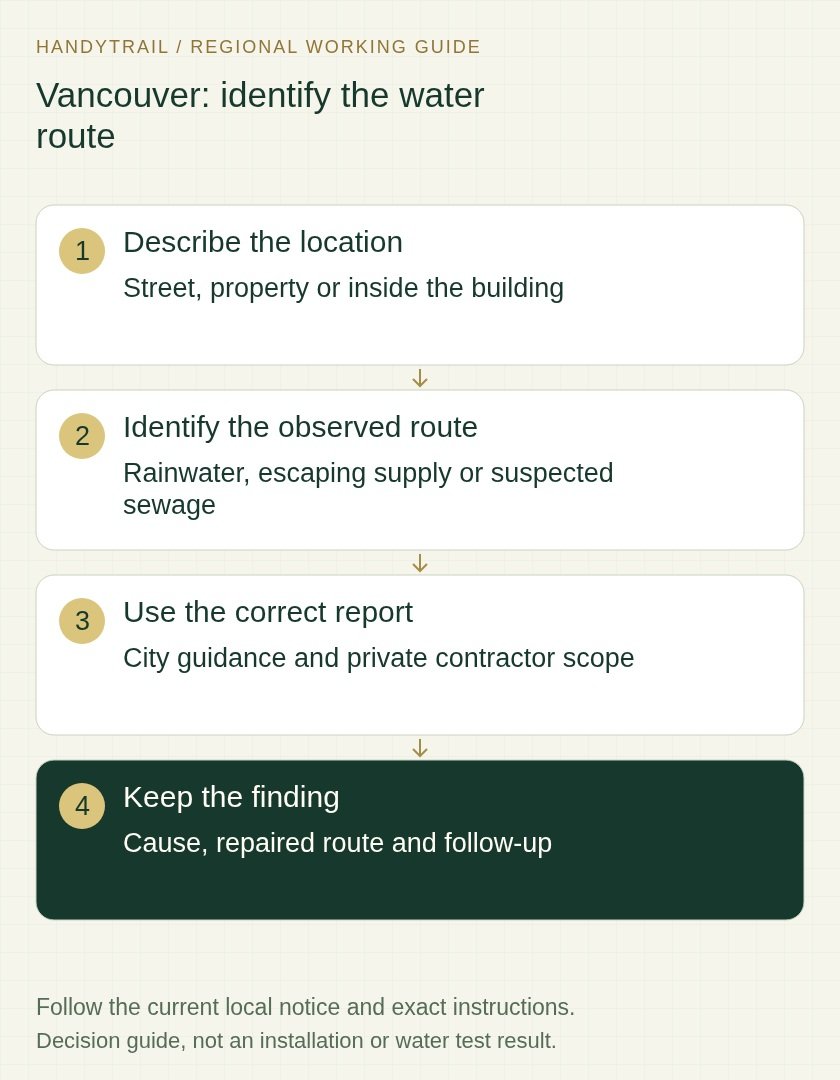
- Describe the location. Street, property or inside the building
- Identify the observed route. Rainwater, escaping supply or suspected sewage
- Use the correct report. City guidance and private contractor scope
- Keep the finding. Cause, repaired route and follow-up
Keep private-property work separate
The City’s guide to leaks, floods and sewage problems distinguishes reporting and service routes for different situations. Use it to identify the appropriate contact, then confirm the responsibility for the actual problem rather than assuming every visit is free.
For a private driveway drain, ask a contractor which route is being inspected and what access is required. A drain clearing, camera survey, excavation and restoration can be separate work. Request findings tied to the inspected location.
A private-property problem can coexist with a public incident. Keep the City reference and contractor’s observations together so the next person can see what has already been assessed. Avoid approving a large pipe replacement solely because a nearby street flooded.
| Observed location | What to include in the report |
|---|---|
| Street catch basin | Nearest address, side of road and visible obstruction |
| Private driveway or yard | Where water collects and the property boundary |
| Indoor floor drain or toilet | Which fixture is affected and when use stopped |
| Unknown route | State the uncertainty rather than naming a failed sewer |
Treat an indoor backup as its own event
If wastewater rises inside, stop the affected use and seek the appropriate service or building-management response. Do not repeatedly flush toilets or run appliances to demonstrate the symptom. Mention any chemicals already put into a drain before a professional starts work.
Describe which fixtures were affected and whether the issue began during normal use or an observed storm event. In a shared building, management may need to coordinate access and responsibility beyond one unit. Do not operate shared valves or open a common cleanout yourself.
Photograph damage only from a safe area. Avoid handling contaminated material as though it were ordinary rainwater. Keep the water-damage response, drain diagnosis and any insurance documentation as related but separate tasks.
Look at the property’s ordinary rainwater route
Vancouver’s private-property rainwater information provides context for managing runoff. It is not permission to redirect a downspout, driveway drain or sump outlet into whichever pipe is nearest.
After the immediate problem is controlled, ask whether grading, gutters, drainage or a damaged component needs assessment. Changes can affect neighbouring land and the public system. Obtain the relevant design and approval advice before altering the route.
For a hypothetical report, a driveway pond at a low point and a dry indoor floor drain give a different starting description from water rising through an indoor fixture. Neither observation proves the final repair. It helps define the appointment and the evidence the professional should collect.
Keep one location-based incident record
Store the original photos, report reference, weather context, contractor’s findings and completed work in one folder. Add a simple sketch labelling observed locations without presenting it as a verified underground survey.
Ask what remains uninspected and which symptom should trigger another call. A single cleared grate is not a complete assessment of a property’s plumbing, just as a dry basement immediately after pumping does not locate the cause.
When the next heavy rain arrives, compare only observations that can be made safely. The practical gain is a clear reporting route and an explained repair, not a habit of treating every surface puddle as the same infrastructure failure.
Frequently asked questions
Should I lift a street grate to clear it?
Do not lift covers, enter chambers or work in traffic. Use the City reporting route and follow its safe guidance.
Does street ponding prove my home sewer is blocked?
No. The street drainage and private-property plumbing need to be assessed on their actual routes.
Related practical guides
For background recordkeeping and equipment questions, these guides can help. The local authority and supplier instructions above govern the regional response.