A filter package may show a gallon capacity, a month interval or both. Those values answer related but different planning questions. A calendar reminder based only on “about six months” can miss a heavier-use household, while a rough gallon estimate cannot replace a stated time requirement.
Read the exact cartridge instructions and performance information first. This guide helps you turn those instructions into a practical reminder. It does not extend a service life, measure remaining capacity or prove that a contaminant is still being reduced.
Copy the replacement wording exactly
Record the system model and replacement element. Then copy the relevant volume, time and operating conditions without shortening them into a universal rule. If the instructions say “whichever comes first,” keep that wording in the reminder. If the wording is unclear, ask the manufacturer how the limits apply together.
NSF’s guidance on changing water filters explains that service cycles may use gallons or a month estimate and recommends following the manufacturer’s interval and proper replacement cartridge. That advice does not mean all filters have the same schedule.
A housing label and a replacement-element label may contain different information. Keep the exact element identification with the schedule, particularly if the system accepts several elements with different supported claims.
Record the service-life starting point
Follow the model’s preparation and commissioning instructions. Ask when its stated service cycle begins if the instructions distinguish flushing from use. Do not assume the day the parcel arrived is the start of the installed cartridge’s service life.
Write the installation date, preparation completed, cartridge identification and any indicator-reset instruction. Keep the receipt separately; purchase history and installed-use history serve different purposes.
If the cartridge was already installed when you moved in, mark the starting date unknown. Ask the supplier how to establish a maintenance plan under that uncertainty instead of inventing a date from the previous owner’s estimate.
Use arithmetic as a planning aid
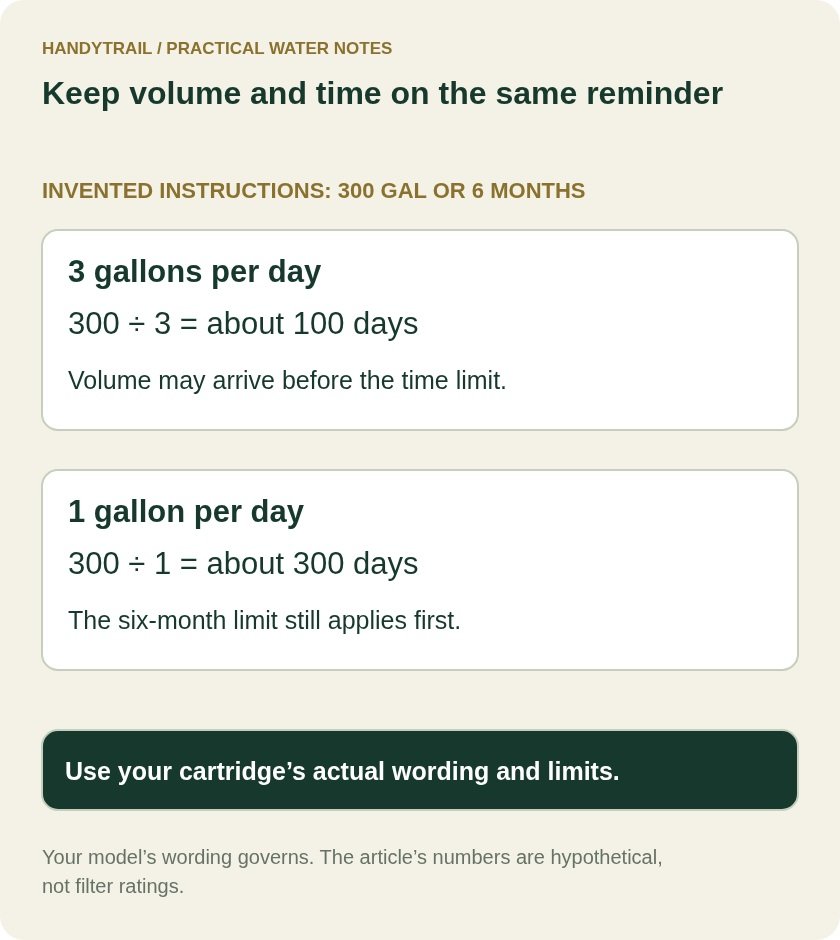
Imagine an invented cartridge whose instructions require replacement at 300 gallons or six months, whichever comes first. If a household routes about 3 gallons per day through it, the volume estimate reaches 300 gallons after about 100 days. At 1 gallon per day, reaching that volume would take about 300 days, but the six-month requirement would still matter.
These numbers are hypothetical. They are not ratings for a named cartridge. Daily use can change, and rough household estimates are not a measurement of adsorption capacity. Keep all model-specific conditions and earlier replacement instructions in the plan.
- Copy the instructions: Exact cartridge + claim.
- Record the start: Installed + prepared as directed.
- Track the applicable limits: Gallons + calendar + conditions.
- Replace as directed: Record part + reset correctly.
Working record
| Field | What to record |
|---|---|
| Cartridge | Exact element and supported claims |
| Instructions | Copy time, gallons and conditions |
| Start | Installation/preparation record |
| Use estimate | Relevant outlet use; uncertainty noted |
| Action | Next review/replacement and part |
Distinguish the reminder from a contaminant sensor
Find out how your system’s indicator works. It may be based on time, counted use or another model-specific method. Do not assume a green light means the device directly measured every contaminant named in the performance sheet.
A taste change or slow flow can justify investigation, but normal taste and flow do not establish remaining reduction capacity. Likewise, a flow restriction is not necessarily the same event as exhausting adsorption capacity.
Ask the manufacturer how to respond if the reminder, observed use and written instructions appear inconsistent. If your water is under an advisory or the equipment has been frozen or damaged, ordinary calendar arithmetic is not the restart procedure.
Allow for changes in household use
Guests, a new drinking-water habit or additional use at a filtered outlet can change the volume estimate. Update the estimate with a dated note rather than keeping the old reminder simply because it was convenient.
For planning, list the uses actually routed through that filter: drinking, cooking or another supplied appliance. Do not include every gallon on the whole-house bill for a filter serving only one outlet. If you cannot estimate volume reasonably, ask what monitoring method the model supports.
A pitcher and a whole-house element require different records. Our filter cost-per-gallon guide can help with a budget once the suitable service cycle is known; cost arithmetic does not determine when a cartridge is safe to keep using.
Make the next reminder useful to another person
Store the exact replacement part, applicable limits, installation date, estimated use if relevant, next action and source document. After replacement, record the work and reset the indicator only as instructed. Keep the previous entry so you can review the actual interval later.
The best reminder states both the action and its basis: “Review exact cartridge instructions; planned replacement from documented time and use limits.” It should not imply that a calendar notification or a household calculation has verified treatment performance.
Practical questions
Does a normal flow rate mean the filter can stay in service?
Normal flow does not establish remaining contaminant-reduction capacity. Follow the exact cartridge’s replacement instructions and investigate changes as directed.
What if the package lists both gallons and months?
Read the exact wording and any conditions. If it specifies whichever comes first, preserve that requirement. Ask the manufacturer when the wording is unclear.
Is a daily-use calculation a performance test?
No. It is a planning estimate. It does not measure adsorption capacity, replace model instructions or verify contaminant reduction.