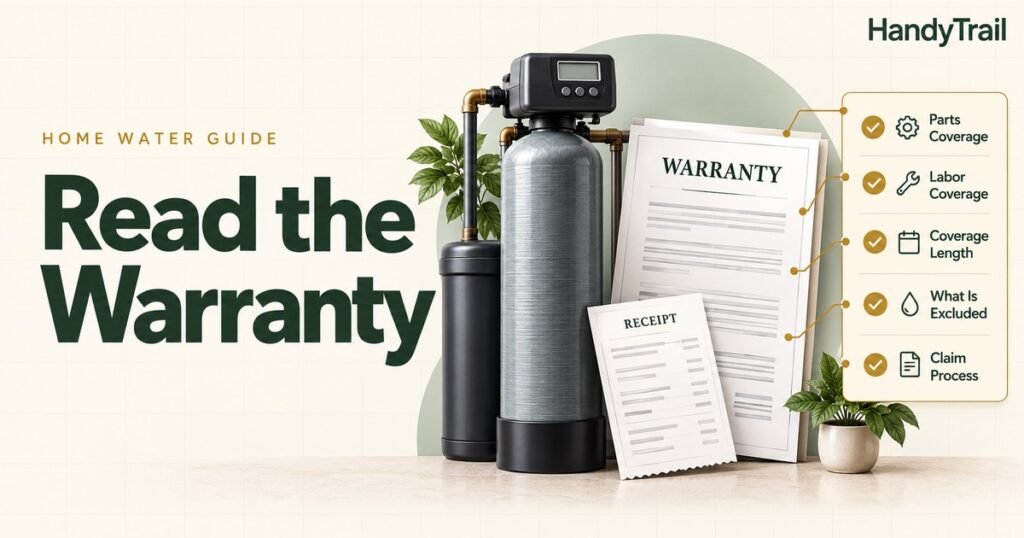
“Long warranty” is not a complete description of what happens when water-treatment equipment needs repair. A vessel, valve, electronic controller and installation labor may have different coverage. The document that identifies the model and terms matters more than a headline on a sales page.
Ask for the warranty before buying, and keep a dated copy with the quotation. This guide is a document-comparison worksheet. For a dispute about legal rights or enforceability, ask your state consumer protection office or a qualified adviser.
Obtain the document for the actual purchase
Identify the manufacturer, exact model, seller and product condition. Ask whether the document applies to the item being quoted, including a used, refurbished or replacement unit. A generic brand warranty may omit a specific product’s terms.
The FTC’s consumer warranty guidance recommends reviewing written coverage and keeping the warranty with the receipt. Use the written terms to resolve a sales claim before the purchase, rather than assuming a spoken promise will appear in a later document.
Save the document’s date or revision when available. If a seller points to a web page, keep a copy of the relevant terms and request clarification of any mismatch between that page and the quotation.
Separate coverage by component and cost
Make rows for vessel, control valve, electronics, treatment media, fittings and installation work when those items are part of the purchase. Use the warranty’s own component names. Leave a blank or “not stated” where a term is unclear; do not infer that every part shares the longest period.
Add columns for parts, labor, diagnosis, travel and shipping. Ask who pays each expense and who authorizes the repair. A part supplied without charge does not necessarily make an onsite visit free.
A hypothetical comparison has one offer stating parts coverage and another stating parts plus a defined labor period. That difference deserves a question even if both advertisements display the same headline duration. The example is a comparison method, not a description of any particular brand.
Review conditions with the installation proposal
Look for operating and installation conditions relevant to your home. Ask the seller how the proposed location, water conditions and maintenance plan fit those terms. Keep any unanswered question attached to the quotation.
Do not interpret a document’s exclusions as proof that your installation is suitable. If freezing, pressure or a particular water condition is mentioned, obtain an appropriate assessment before buying. A warranty should not be used as a substitute for correct sizing or verified treatment claims.
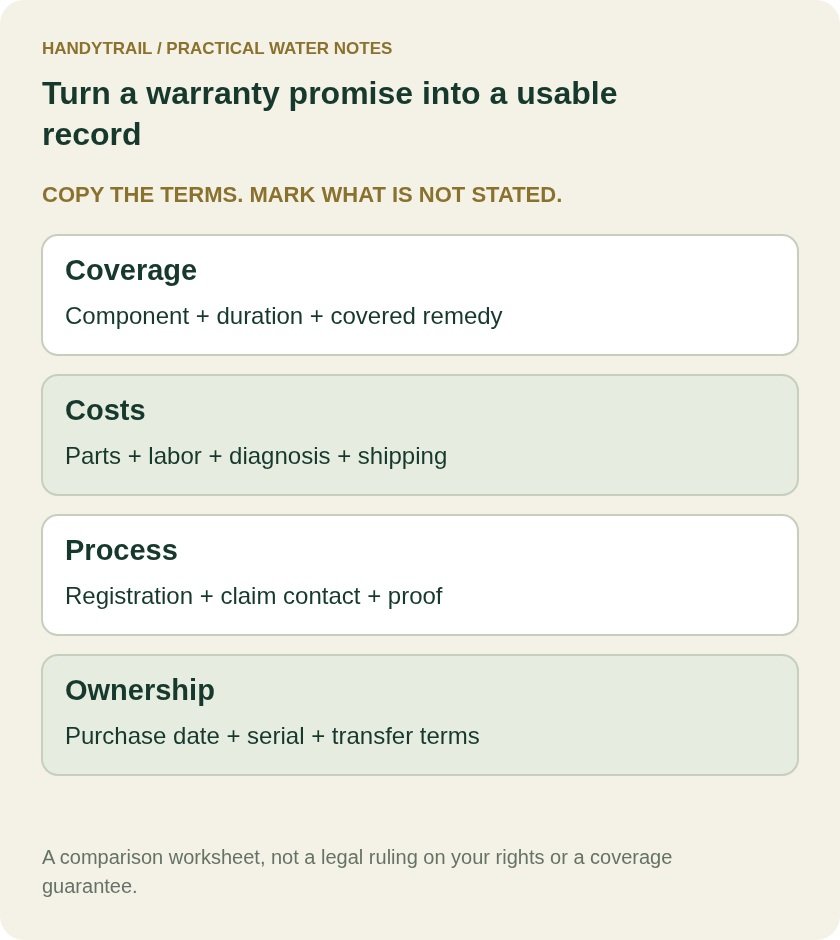
- Read before buying: Exact model + warranty edition.
- Map coverage: Parts, labor, exclusions.
- Confirm the process: Registration + claim contact.
- Keep proof: Receipt + serial + service.
Working record
| Field | What to record |
|---|---|
| Applicable document | Exact model and warranty edition |
| Component coverage | Duration and remedy for each part |
| Other costs | Labor, diagnosis, travel and shipping |
| Process | Registration, claim contact and proof |
| Ownership | Receipt, serial number and transfer terms |
Confirm registration and ownership details
Ask what registration is requested, which information is needed, how completion is confirmed and whether any deadline affects a stated benefit. Save the confirmation rather than assuming a submitted online form was accepted.
Do not conclude that failing to register removes every possible legal protection. Written terms and consumer rights can involve different questions. If there is a disagreement about the effect of registration, obtain advice appropriate to your state and situation.
For equipment already in a home, ask whether coverage transfers, what proof is required and whom the new owner should contact. An installed serial number does not establish that a previous owner’s purchase or a transfer requirement has been documented.
Distinguish the warranty from a paid service contract
A maintenance plan may cover scheduled visits, consumables or callouts that are different from a product-defect warranty. The FTC’s explanation of extended warranties and service contracts helps identify that distinction and possible overlap.
Put the product warranty and paid plan in separate columns. Record their providers, included work, exclusions and claim procedures. If a salesperson says the paid plan is required, ask for the specific written basis and seek appropriate consumer advice if necessary.
Our water-treatment service-contract guide addresses the plan itself. This worksheet focuses on the product coverage so the two purchases can be compared without combining their promises.
Prepare a concise claim file if a problem develops
Record the model, serial number, purchase and installation dates, symptom, when it began and any relevant service history. Keep photographs, receipts and the original terms. Report what happened rather than diagnosing a defective component from an internet discussion.
Use the claim contact and process stated in the applicable document. Ask for a reference number and the next required step. Do not authorize additional paid work based solely on an assumption that it will later be reimbursed.
Before purchase, a complete worksheet reveals unanswered costs and responsibilities. After purchase, the same folder gives the seller or manufacturer the information needed to review a claim. Neither step guarantees coverage, but both make the conversation clearer.