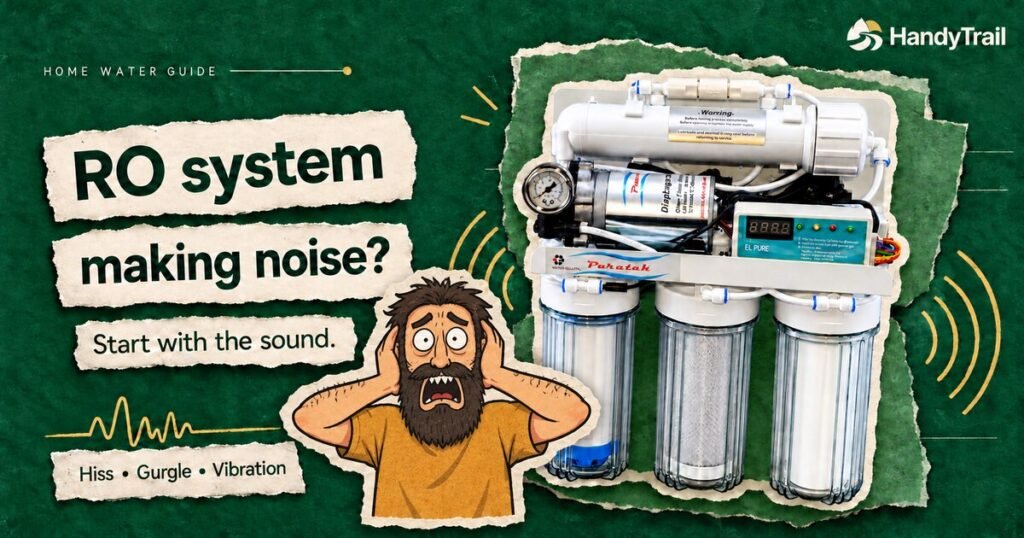
An under-sink RO system fills slowly, and a seller suggests “adding a pump.” That description leaves a major question unanswered: which kind of pump, and which part of the process is it meant to improve?
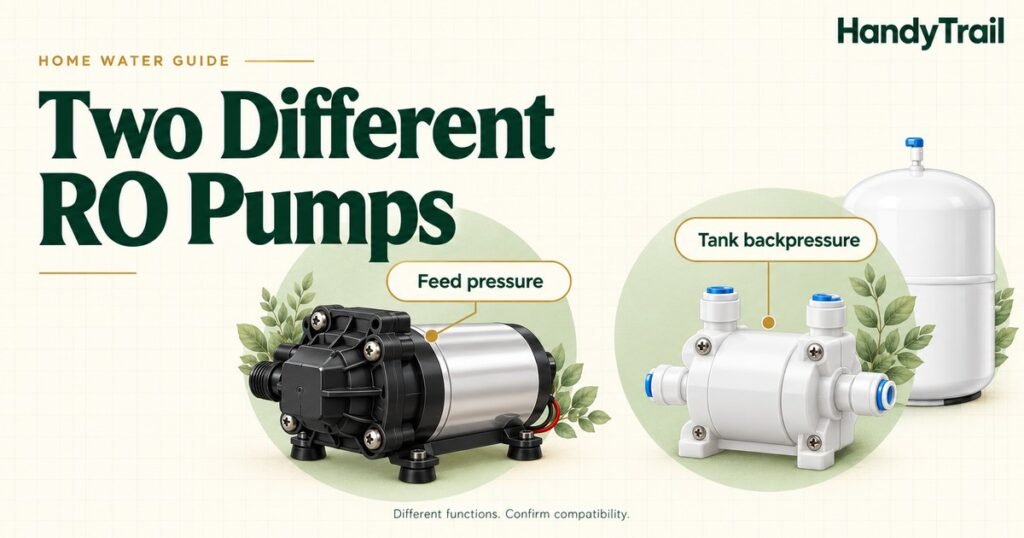
A booster pump and a permeate pump have different functions. Start with the symptom and the exact RO model before deciding that either upgrade fits. This guide explains the comparison and the questions to take to the system supplier; it does not provide retrofit wiring, tubing routes or pressure settings.
Suggestions only—not a paid promotion. Manufacturer examples are used to explain documentation; no hands-on product testing is claimed.
Separate faucet flow from water production
Describe what you observe. Does the faucet begin strongly and then slow? Does the storage tank seem to take longer to refill under comparable conditions? Are other household taps also affected? Record recent maintenance and changes to the supply.
Those observations point to different questions. A slow RO faucet is not automatically evidence that the membrane needs more feed pressure. Likewise, a short refill observation after drawing a small glass is not a complete production assessment.
Use our RO refill-record guide to keep the observation conditions consistent. Record the test procedure from the exact model documentation rather than creating a tank-pressure experiment.
Understand what a booster pump is intended to do
In the relevant RO design, a booster pump increases feed-water pressure to the membrane. Its controls and power supply must fit the system. It is not a general repair for every low-flow or tank problem.
Aquatec’s RO boost-pump technical guide distinguishes feed-pressure boosting from the separate function of a permeate pump. That document describes particular equipment and technical service tasks. Do not copy its pressure values or troubleshooting procedures into a different system.
For a proposal, ask which documented operating limitation has been identified and how the suggested pump addresses it. Keep the answer tied to your RO model and actual operating conditions.
Understand what a permeate pump is intended to do
For compatible tank-based systems, a permeate pump addresses the effect of storage-tank backpressure on RO operation. It is different from increasing the supply pressure before the membrane. Some designs use energy from the reject-water stream rather than an electrical motor.
The Aquatec ERP500 and ERP1000 product document describes those specific devices. Any manufacturer performance statement belongs to its documented equipment and conditions; it is not a measured improvement for your home.
Do not assume that a tankless appliance accepts a component intended for a conventional storage-tank system. Ask the RO manufacturer whether the proposed device is supported before comparing a claimed benefit.

- Describe the symptom: Slow refill or slow faucet?
- Identify the function: Feed pressure or tank backpressure.
- Confirm compatibility: Exact RO + controls + manual.
- Verify the plan: Supported measures + service.
Working record
| Field | What to record |
|---|---|
| RO identity | Exact system and membrane model |
| Symptom | Faucet behavior or refill observation |
| Proposed component | Booster/permeate; exact pump model |
| Compatibility | Written confirmation and manual |
| Verification | Supported before/after procedure |
Make the comparison around your system
Use a worksheet with model, membrane identification, storage arrangement, current controls, symptom record and proposed pump model. Add the supplier’s compatibility confirmation and the manual revision used for the proposal.
Ask whether existing shutoff controls, tubing, fittings, power supply and service space remain suitable. These are design checks for the provider, not instructions to remove a valve or bypass a switch. If the system has an alarm, leak or unexplained continuous operation, resolve that condition rather than using an upgrade to mask it.
Aquatec describes an arrangement using both pump types in its technical guide. That establishes that certain designed combinations exist; it does not show that any two pumps can be combined on any household RO system.
Ask how the benefit will be assessed
Specify the outcome you want to compare: refill behavior, supported operating pressure, delivered flow or efficiency under a documented procedure. Ask what will be measured before and after and what conditions must stay comparable.
Keep a hypothetical improvement estimate separate from a guarantee. If a proposal mentions a percentage saving, ask for its basis and whether it applies to the exact system. Do not infer a new contaminant-reduction claim from faster tank filling or a lower reject-water volume.
Our RO efficiency guide explains how performance comparisons need suitable definitions. A pump upgrade changes an operating arrangement; certified treatment claims still belong to the listed system and its supported configuration.
Compare the whole upgrade scope
Request a written scope naming the component, installation work, commissioning check, maintenance implications and coverage. Include any electrical or access requirement in the quote. Ask whether the system supplier will support the modified arrangement.
An appropriate decision may be a supported upgrade, ordinary maintenance or further investigation of the existing system. The useful question is not “Which pump is better?” It is “Which verified problem does this particular, compatible device address?”