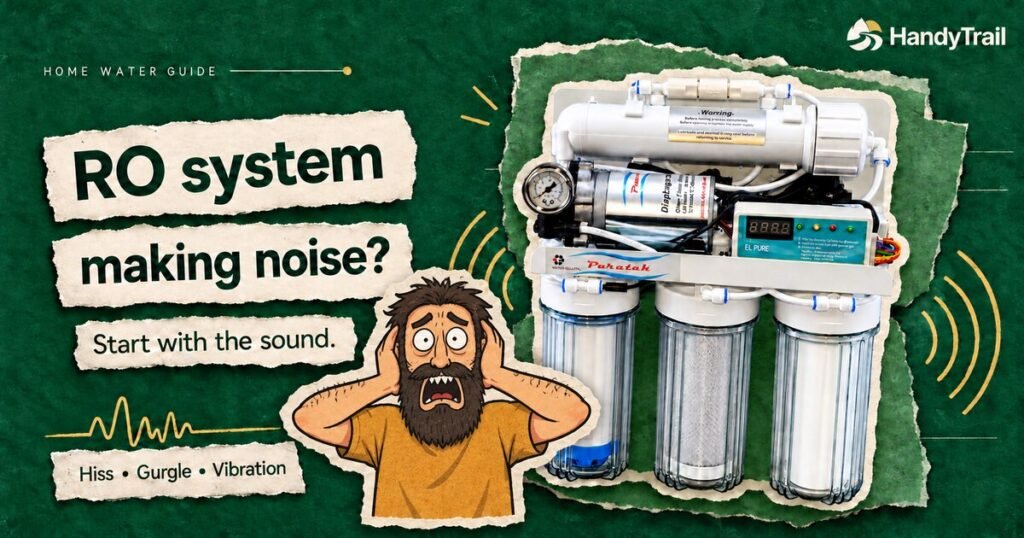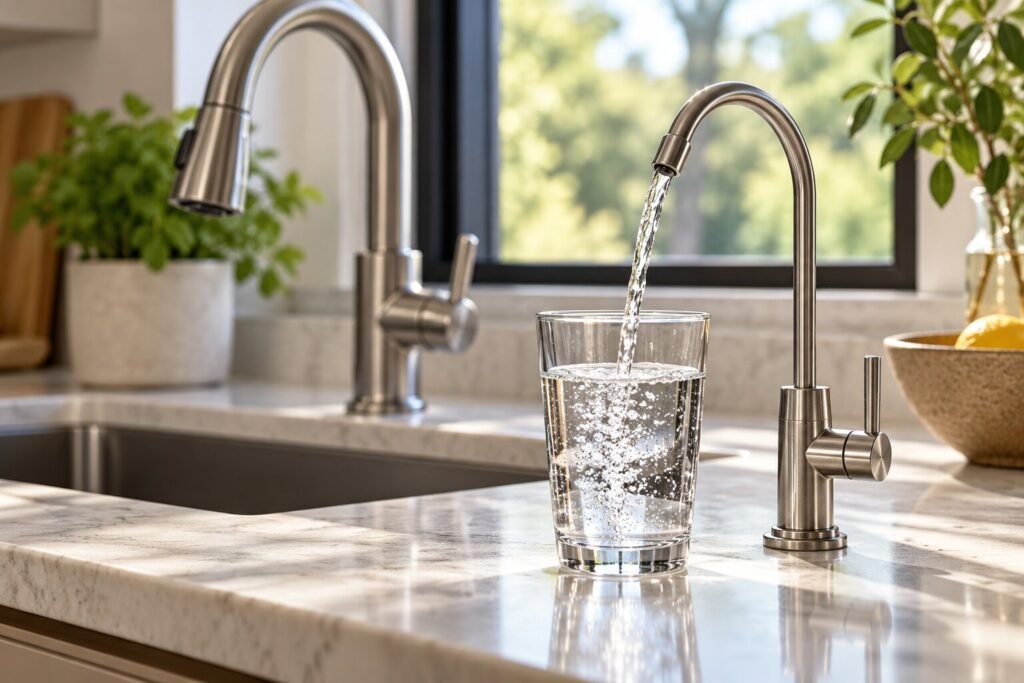
If the drinking-water faucet slows down while the main kitchen faucet works normally, start by documenting the RO system's behavior. That difference helps narrow the investigation, but it doesn't prove that the membrane, storage tank or a particular cartridge has failed.
A tank-based system can deliver stored water at a different rate from the rate at which it produces new water. Note whether the flow is weak immediately or starts stronger and fades after several glasses.
Compare the same conditions
Choose an ordinary cold-water observation, not a moment when several other fixtures are running. Record which faucet is affected, roughly how much water was drawn beforehand and whether the problem is new. If the whole house is also slow, tell the plumber that the issue is wider than the RO faucet.
Don't assume that a recent cartridge change rules out a filter problem. Record the exact replacement parts and whether the manufacturer's startup procedure was completed. Our replacement compatibility guide separates physical fit from the right performance claim.
Check only visible information you can access safely. Photograph a displayed error, a visible kink or a leak without disconnecting pressurized tubing. Use a safely accessible known shutoff if a leak requires it, and arrange service.
Stored delivery and membrane production aren't identical
EPA describes RO as pressure driving water through a membrane, producing treated water and a reject stream. Pentair's RO plumbing example includes a separate storage tank and a post-filter before the faucet. That explains why several parts of the water path may be relevant on a tank-based appliance.
It doesn't establish a universal refill time or a universal tank air-pressure setting. Those values depend on the exact system and the conditions specified by its manufacturer.
For a useful distinction, record both the initial faucet behavior and what happens after the system has had its normal opportunity to replenish. Our RO refill-time guide shows how to organize that observation without declaring a fault from an arbitrary countdown.
Give the technician a short timeline
Include installation date, cartridge service date, when the flow changed and any recent plumbing work. Say whether the system was left unused, shut off or disconnected. Keep the membrane and storage-tank identifiers if they're available on accessible labels.
Ask the technician which checks are needed for incoming pressure, restrictions, stored delivery and control operation on that model. A properly scoped service call is more useful than changing several components and hoping one was responsible.
Don't pump air into a tank while copying a pressure number from a different system. Don't remove the drain connection or flow-control components to make the faucet appear faster. These changes can interfere with operation and require the correct model procedure.
Confirm the result after service
Repeat your original faucet observation under comparable conditions and retain the repair details. If treatment performance is also in question, follow the appropriate verification plan. A stronger stream alone isn't proof that the system is achieving every advertised contaminant reduction.
Use the post-installation verification guide when discussing that separate question. Flow and water quality deserve their own evidence.
Pentair is included as an unpaid documentation example, not a product recommendation or a claim of hands-on testing.