Location: Québec. Official guidance checked 18 October 2026. Follow the latest local notice for your address.
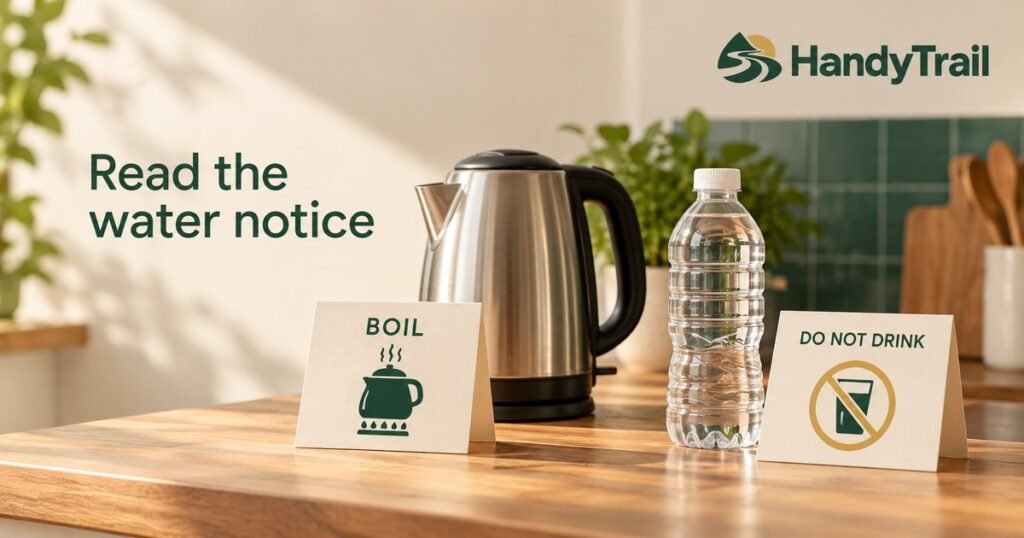
A Québec water notice should change what the household does, not merely what it calls the problem. A boil-water advisory, an instruction to avoid drinking tap water and a do-not-use advisory describe different restrictions. Treating them as interchangeable can lead to the wrong response.
Read the municipality or distribution operator’s current notice for your address. This article explains the decision process in English, with the French terms you may encounter. It is not a live list of affected Québec streets and cannot lift or replace an official instruction.
Match the notice to the actual water system
Start with municipality, distribution area, affected streets and date. A shared screenshot may concern a different sector or an earlier event. Look for the latest update on the official operator’s channel and retain the link rather than relying on a forwarded image alone.
The province’s advisory information explains the public notification context. A notice for a municipal network does not measure a separate private well. Likewise, living outside the mapped municipal area does not establish the quality of a property’s own source.
In a rental or apartment, ask management whether the building receives the named supply and whether shared storage or treatment requires additional action. Keep the operator’s instruction and the building’s implementation details together without treating one as a substitute for the other.
Read the French term without changing its meaning
An avis d’ébullition concerns boiling as specified. An avis de non-consommation concerns avoiding consumption. An avis de non-utilisation is a stronger restriction on use. The full text controls the action, including any exceptions or additional precautions.
Québec’s emergency water guidance sets out the different responses. Do not convert “do not drink” into “boil and drink.” The nature of the concern determines whether boiling is suitable.
If translation leaves a practical question unresolved, contact the municipality or operator. Ask directly about the use you need, such as brushing teeth, preparing food or bathing. Guessing from a single word in the title is less useful than getting the actual instruction clarified.

- Match the address. Municipality and exact distribution area
- Read the full instruction. Boil, avoid drinking or do not use
- Plan each household use. Food, ice, hygiene and appliances
- Check the lifting notice. Follow the stated restart procedure
Make a household-use plan
Create separate rows for drinking, food preparation, ice, oral hygiene, washing and appliances. Copy the notice’s instruction for each relevant use. If a use is not clear, mark it as a question instead of assuming all non-drinking tasks are allowed.
Include every person who uses the kitchen, including visitors and carers. A note at one tap may not reach someone using the refrigerator dispenser. Communicate the same instruction in a form household members can understand, without adding a homemade treatment claim.
For a hypothetical household, the immediate plan could identify an approved alternate source for drinking and food while a specific hygiene question is referred to the operator. That is a planning example, not permission to use restricted water for a purpose omitted from the notice.
Include filters and ice equipment
A softener or taste-and-odour cartridge does not establish protection against the reason for an advisory. Record which outlets feed the refrigerator, ice maker and countertop equipment. Ask how the official instruction applies to the actual arrangement.
Do not run an appliance simply to “flush the problem out” while the restriction remains unresolved. Its internal storage and service requirements may differ from the building pipework. Save the model and manual so the manufacturer can answer a precise restart question later.
Keep hot liquids and emergency containers away from children. Use clean containers intended for water and clearly distinguish drinking water from water reserved for another approved use. Do not reuse a container that held cleaning chemicals.
| Québec household setting | What needs confirmation |
|---|---|
| Montréal or Laval address | The municipality and network named in the notice |
| Québec City or another municipality | Exact affected streets, dates and latest update |
| Private well outside a municipal network | Separate well-owner testing and local advice |
| Apartment or shared building | Management notice and shared equipment responsibilities |
Know which contact can answer the regional question
In Montréal, Laval, Québec City or another municipality, the exact network notice matters more than the province-wide label. The table is a guide to finding the right record, not a claim that a listed place currently has an advisory.
For a private well, describe the source, recent weather or work and the observed change to an appropriate local contact or laboratory. A municipal lifting notice cannot clear a well that is not part of that system. Keep the testing question separate from a public-network update.
If someone has a specific medical or equipment-related need, ask the relevant professional for instructions suited to it. A general household checklist cannot establish suitability for infant feeding, a medical device or a particular health condition.
Close the event with the official lifting instructions
A repaired main and restored pressure do not necessarily mean an advisory has been lifted. Wait for the explicit update from the responsible operator. Record the time and any instructions about flushing, ice equipment and treatment devices.
Then follow the applicable appliance guidance rather than assuming every cartridge needs the same action. Ask about unclear steps before restoring the affected use. Keep receipts or service notes when equipment work was required.
Finish with a short event record containing the notice, affected address, household actions, lifting message and any remaining task. This makes the next interruption less confusing while preserving the important distinction between boiling, avoiding consumption and avoiding use.
Frequently asked questions
Will boiling make every restricted supply usable?
No. Boiling is not a universal response to a drinking-water avoidance or do-not-use advisory. Follow the actual notice.
Does a filter let me ignore the municipal advisory?
Do not assume that. Confirm the instructions for the actual concern and equipment with the responsible authority.
Related practical guides
For background recordkeeping and equipment questions, these guides can help. The local authority and supplier instructions above govern the regional response.