Location: Wales — supplier area and postcode. Official guidance checked 18 October 2026. Follow the latest local notice for your address.
When water returns after a main repair in Wales, three questions need separate answers. Has supply been restored? Is there an unusual appearance? Is any water-use notice still in effect? A tap flowing again answers only the first question.
Start with the supplier’s current incident update for the postcode. This article is a household restart checklist, not a statement that Wales has a current nationwide interruption. A notice for one network or street must not become an instruction for every Welsh home.
Confirm the supplier and the incident
Use the water bill or an official service lookup to identify who supplies the address. Do not assume every property in Wales has the same supplier or that the company handling a wastewater query also supplies its drinking water.
For Dŵr Cymru customers, the company’s after-an-incident guidance and incident information provide the starting point. Check the address scope, update time and any action requested. An estimated repair time is not confirmation that every connected home has normal service.
If you are in a block of flats, management may need to check shared storage, pumps or treatment. The street network and a building’s internal system are separate parts of the route. Ask what has actually been restored before treating another flat’s observation as a result for yours.
Keep an advisory separate from an engineering update
A message that a main is repaired may describe the engineering work while a quality precaution follows a different process. Read both parts. If an advisory was issued, look for an explicit lifting notice and any return-to-use instructions.
Do not use taste or clear appearance to override a notice. A household filter also does not establish that the reason for a precaution has been resolved. If the wording is unclear, ask the supplier how the instruction applies to drinking, food, ice and hygiene.
Make one household note with the incident reference, affected address, current restriction if any and the next official update. That is easier to keep accurate than several screenshots without dates.

- Check the incident update. Supplier, postcode and repair status
- Read any quality instruction. Restored flow is not a lifting notice
- Describe the change. Air-like cloudiness, colour or affected outlets
- Restart as instructed. Supplier guidance and equipment manual
Describe appearance without calling it a test
The company’s water-appearance information explains different reported changes. Air-like cloudiness and visible discolouration are not identical descriptions. Neither can be turned into a contaminant finding from a photograph alone.
Describe what you already observed, which outlets were affected and whether the change appeared immediately after the interruption. Include any unusual smell without deliberately tasting the water. Avoid repeatedly filling and drinking glasses to decide whether the problem has gone away.
Ask the supplier which observation or action is appropriate for the actual event. Do not borrow a long flushing time from an old construction project notice in another area. Instructions can depend on the network, event and current restrictions.
Protect the record before changing filters
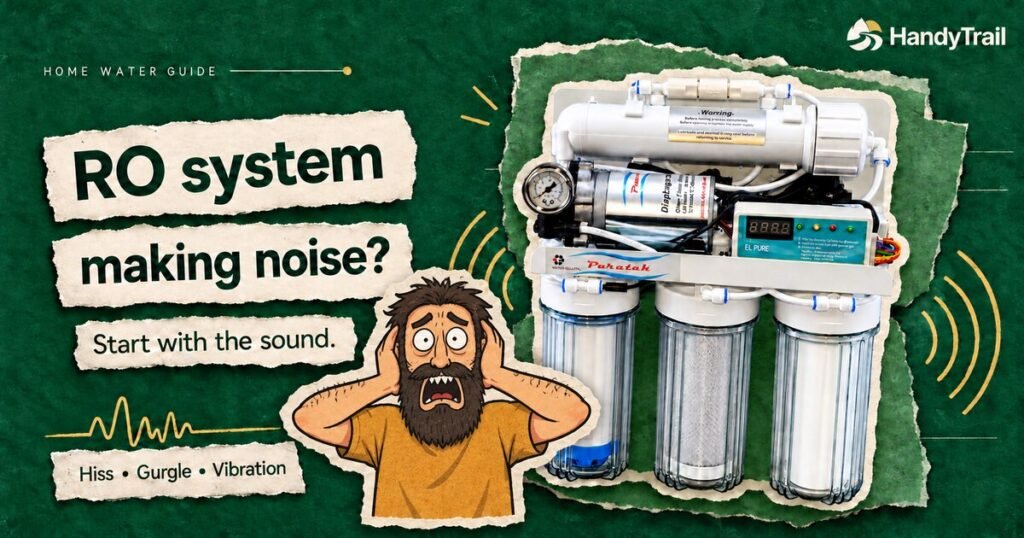
Write down the equipment feeding affected outlets. Is it a refrigerator cartridge, a whole-house sediment stage or a dedicated drinking-water unit? The original symptom and equipment condition are useful to the provider before several components are changed at once.
A dark cartridge, a changed flow rate and a supply notice answer different questions. A replacement element may be necessary under model instructions, but its appearance alone does not establish the source material or every cause of the event.
Keep the exact element identity, installation date and recent work with your notes. If professional service is needed, ask whether the visit covers the device, the building plumbing or liaison with the water supplier. Different tasks should have a clear scope.
| Welsh household situation | Useful next step |
|---|---|
| Dŵr Cymru customer in north or south Wales | Read the current incident and quality guidance for the postcode |
| Another supplier or border-area address | Confirm the actual water company first |
| Apartment or shared building | Ask management about storage and shared equipment |
| Private source outside the public network | Use a separate owner and local-authority assessment |
Follow the right restart procedure for appliances
A water supply can serve ice equipment, a dispenser, treatment and other appliances with internal storage. Ask about each relevant model’s return-to-use requirements. A supplier instruction for pipework is not automatically a complete maintenance procedure for every device.
Do not run a machine without a suitable supply or open a pressurised filter housing to inspect it. If a device has alarmed, leaked or lost its required operating conditions, follow its documented response and seek qualified help where necessary.
A practical restart sheet can have columns for device, applicable instruction, task completed and unresolved question. Leave an item open until the responsible person has clarified it. Resetting an indicator should document completed work, not hide an unanswered maintenance issue.
Know when a local problem needs another contact
If the supplier says the network is restored but your property remains affected, report the distinction. State whether the issue involves one outlet, the whole home or a shared building. Do not change a pressure setting to mask an unexplained restriction.
For tenants, notify the landlord or managing agent about a suspected internal fault. For a private source, obtain a separate local-authority or professional assessment; the public network’s repair update does not describe that source.
Close the record with the supplier’s final instruction, any equipment service and the next ordinary observation. The aim is a controlled return to use with clear responsibility, rather than treating a restored tap or a fresh cartridge as proof that every question has been answered.
Frequently asked questions
Does restored pressure prove that a boil notice is over?
No. Wait for the responsible supplier’s explicit lifting notice and follow its instructions.
Must every cartridge be replaced after a repair?
There is no universal instruction here. Ask the supplier and equipment manufacturer about the actual event and device.
Related practical guides
For background recordkeeping and equipment questions, these guides can help. The local authority and supplier instructions above govern the regional response.