Location: United States, with California and Maui recovery examples. Official guidance checked 19 October 2026. Follow the latest local notice for your address.
A house can escape the flames while its water service remains under restrictions. Another home may be far from the burned neighborhood but receive water from a watershed affected by the fire. Those are different pathways, and they call for different information.
For a home on public water, begin with the supplier’s current notice for the exact service address. This guide explains how to ask better questions about the source and the pipes. It is not a current advisory map, a clearance for any property or a private-well return-to-use procedure.
There are two routes worth separating
One route begins upstream in the watershed. Fire can change conditions that affect water reaching a treatment plant. The other involves the distribution network itself, including damaged infrastructure and loss of pressure. A statement about one route does not settle the other.
EPA’s research on wildfires and drinking-water quality examines effects on source water and treatment. That research is a reason to ask the supplier how its own sources and operations were affected. It does not establish that every fire causes a drinking-water violation downstream.
Ask the utility to identify the affected source, treatment facility or pressure zone. If the answer is that the source was not affected, ask separately whether any distribution damage or service restrictions apply to your address. Keep these questions together without merging them into a single assumption about safety.
California’s recovery guidance addresses damaged networks
The California Water Boards’ wildfire recovery information describes support for local systems issuing advisories, assessing infrastructure and protecting water quality. It also identifies contamination concerns where systems experienced low or no pressure.
This is why the appearance of your building cannot determine the status of the water service. An intact fixture sits at the end of a much larger network. Ask whether the supplier’s restriction applies to the whole system, a pressure zone, a street segment or individual connections.
Do not use an old incident’s list of affected utilities to decide whether a new fire affects you. The supplier, geography and damage will differ. Look for the current date, incident name and issuing agency each time you check an update.

- Identify the affected system. Confirm your supplier and advisory zone
- Separate the two routes. Watershed runoff and damaged pipes differ
- Follow the actual notice. Check permitted uses for your address
- Confirm the recovery steps. Ask about clearance and equipment restart
Maui illustrates why main lines and service laterals differ
EPA’s account of Maui water-infrastructure recovery describes pressure loss and the investigation of potential contamination in distribution and service pipes. Recovery work included sampling main lines and evaluating lateral connections, with damaged or contaminated laterals isolated as appropriate.
The lesson for homeowners is the scale of the clearance. A result from a main line is not automatically a result from every service connection or every building fixture. Ask which part of the system has been assessed and which part remains subject to instructions.
Maui’s account is an incident-specific example. It does not provide a universal sampling panel, a flushing duration or permission to reconnect a damaged property. Your utility and responsible health authority must explain the recovery steps for the incident affecting your service.
Read the notice as a set of permitted uses
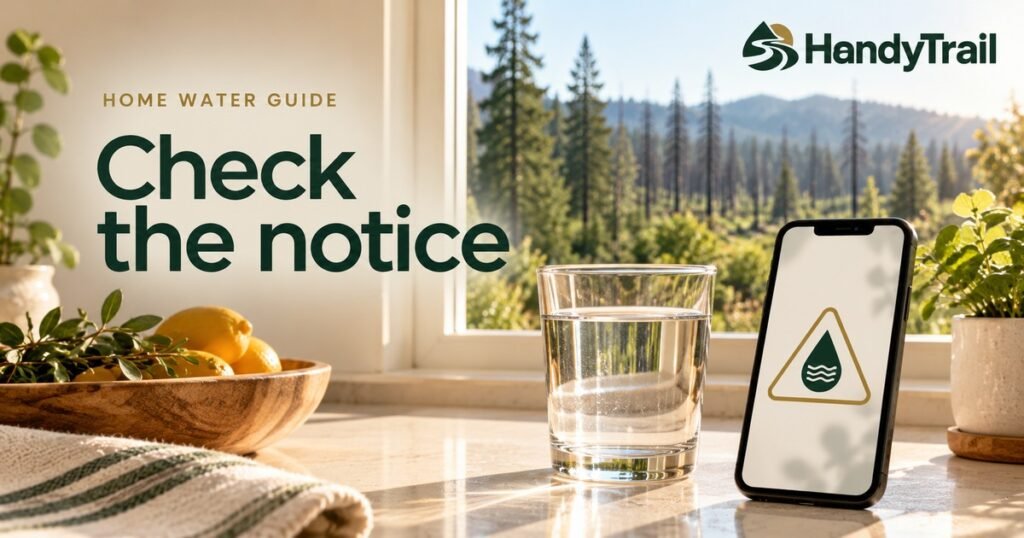
Save the actual notice, not just a social-media summary. Record its issue time, service area and contact details. Ask about drinking, cooking, tooth brushing, pets, bathing and appliances when the notice does not make those uses clear.
A boil-water notice and a do-not-use notice are not interchangeable. CDC’s advisory guidance explains the distinction. Do not improvise chemical treatment, boil water contrary to a chemical advisory or assume an installed filter creates an exemption.
If your household has a medical or equipment-related need, contact the relevant clinician or device provider as well as the supplier. The right question is how to meet that need under the current restriction, rather than whether a generic filtration product sounds reassuring.
| Situation | First record to request |
|---|---|
| Fire in the source watershed | Supplier assessment and source-water updates |
| Loss of pressure or burned services | Distribution-zone notice and recovery plan |
| A neighbor’s zone is cleared | Confirmation for your own service address |
| Filter or refrigerator restarting | Supplier and appliance-specific instructions |
Make a record before restarting equipment
When a notice changes, confirm that the change covers your address. Ask whether any building plumbing, water heater, refrigerator, ice maker or treatment equipment needs a specific restart process. Keep supplier instructions and manufacturer instructions together.
Avoid using a long flushing time copied from another fire. A procedure depends on the identified concern, affected materials and recovery plan. If a professional is carrying out the work, ask what was inspected, which instructions were followed and what evidence supports returning the equipment to service.
A simple recovery folder can hold the notice history, utility case number, contractor record and any laboratory reports. Label samples by location and date. A bottle described only as house water will be difficult to compare with a service-line or distribution result later.
Plan for reliable updates before the next incident
Register for your own supplier’s alerts and save a contact method that does not depend on the same social-media feed as neighborhood discussion. Keep the account or service identifier available so the utility can find the connection quickly.
Include water arrangements in the household emergency plan, along with evacuation and power needs. Check storage and replacement practices against current emergency guidance. The aim is to reduce guesswork during a disruption, not to make a household treatment system responsible for conditions it was never designed to handle.
Once service is cleared, keep the records. They can help explain later equipment work and prevent an old restriction from being mistaken for a new one. A dated, address-specific answer is much more useful than a general statement that the fire is over.
Frequently asked questions
Does an intact house mean its tap water was unaffected?
Not necessarily. The house and the water distribution system can have different damage and recovery histories. Confirm the service address and current notice with the supplier.
Should everyone boil water after a wildfire?
No. Follow the exact local notice. Boiling is not an answer to every type of contamination, and a do-not-drink or do-not-use notice may require different actions.
Related practical guides
Continue with these related explanations. Follow current local instructions for any active notice or investigation.