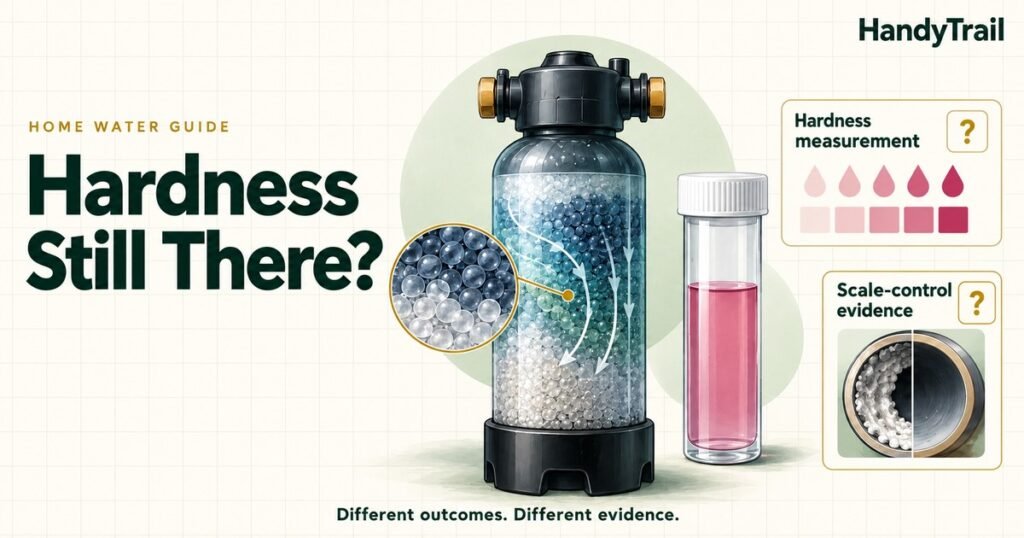
A hardness strip still reads “hard” after a salt-free conditioner is installed. Before calling the equipment a failure or a success, check what the system was intended to do. Removing hardness minerals and addressing scale formation are different treatment objectives.
The phrase “saltless water softener” can blur that distinction. Identify the actual technology, model and promised result in the written proposal. This guide focuses on matching the measurement to that result, rather than repeating a broad softener-versus-conditioner comparison.
Name the outcome you wanted to change
Was the aim a lower hardness concentration, less scale on particular equipment, a different cleaning experience or something else? Write that aim in ordinary language and ask the provider to connect it to a documented model claim.
A hardness result describes a particular water characteristic. It is not a universal score for taste, corrosion, microbial safety or scale behavior under every operating condition. A device should not be judged against a result it was never designed to change, but a broad promise also should not escape scrutiny because the test was inconvenient.
Keep the salesperson’s phrase alongside the exact system description. If one document says “softening” and another says “scale prevention,” ask for that difference to be resolved before treating them as equivalent claims.
Understand the non-removal distinction
Watts describes its OneFlow OF744-10-B as a scale-prevention system that is not a water softener and does not remove minerals. That is a specific manufacturer example, not a finding that every product marketed as salt-free works in the same way.
If the proposed model does not remove hardness minerals, an unchanged hardness measurement can be consistent with its described function. That observation alone does not verify its scale-control performance. Both parts of the statement matter.
Suggestions only—not a paid promotion. The manufacturer reference explains the distinction; we have not independently tested that system, verified an installation in your home or ranked conditioning products.
Keep the hardness test within its own instructions
Record the sampling point, method, unit and date. If the purpose is comparison, check that the locations and procedures are comparable. A treated drinking-water tap, an untreated branch and a whole-house outlet may represent different routes.
Do not change the sample preparation to make a strip show the expected color. Follow the test’s instructions, including its range and reading method. If the result is unclear or outside the test’s useful range, ask about an appropriate laboratory or alternative measurement.
A test strip’s limited resolution also matters. “Looks the same” is not the same as a precise before-and-after analytical result. Preserve the actual observation without inventing extra decimal places.
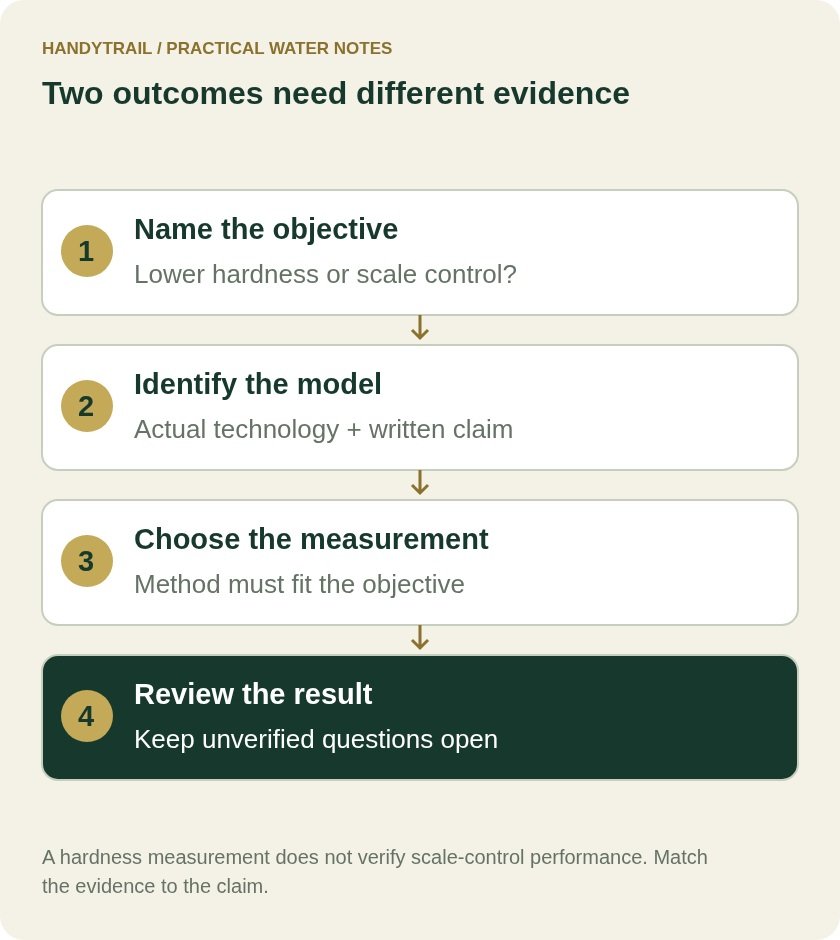
- Name the objective: Lower hardness or scale control?.
- Identify the model: Actual technology + written claim.
- Choose the measurement: Method must fit the objective.
- Review the result: Keep unverified questions open.
| Outcome | Appropriate evidence question | Do not infer |
|---|---|---|
| Hardness concentration | Which suitable test measures the water characteristic? | A complete scale-control verdict |
| Scale-control objective | Which model claim and evaluation fit the application? | That minerals have been removed |
| Drinking-water safety | Which separate source concerns require assessment? | That either observation excludes all hazards |
Ask how a scale-control claim will be checked
Request the model’s supporting evidence, stated operating conditions and a suitable evaluation plan. The Watts OneFlow FAQ is an example of manufacturer documentation describing the technology and its application. Manufacturer explanations should be read with their scope, not transferred to an unrelated device.
Ask which water characteristics, flow conditions and service requirements must be met. Then ask what observation or documented assessment can address the promised outcome. Do not create a home heater-disassembly experiment or use a photograph of a kettle as a substitute for a defined assessment.
If scale is already present, ask whether existing deposits affect what you should expect to observe and over what supported conditions. Do not promise that old scale will disappear on a universal timeline.
Use a two-outcome comparison record
Create separate rows for “hardness concentration” and “scale-control objective.” In the first, record the appropriate test and its result. In the second, record the actual model claim, application requirements and agreed evaluation method. Leave missing evidence visible.
For a hypothetical household, the goal is reducing scale on an appliance while retaining the incoming mineral content. A similar hardness result before and after does not settle the appliance-scale question. In a different household, the goal is genuinely lower hardness for a specified use; a non-removal conditioner may not meet that requirement in the first place.
The examples define questions rather than prescribe products. If your equipment requires water within a particular hardness range, use the equipment’s requirement and the actual treatment design rather than assuming that the word “conditioned” meets it.
Investigate a mismatch before changing equipment
Provide the installer with the original goal, model, service record, sampling locations and observed result. Ask whether the issue is an unsuitable objective, an operating-condition mismatch, a maintenance issue or evidence that the stated performance was not achieved. A single strip does not sort all of those possibilities.
Do not add salt, cleaner or another medium to a conditioner based on a generic softener tip. The equipment categories can have different care requirements. Use the exact manual and ask for a written plan before a modification.
A useful conclusion identifies which outcome has been measured and which remains unverified. An unchanged hardness test can be explainable without proving that a conditioner works, and a reduction in visible scale is not a complete drinking-water safety assessment.
Frequently asked questions
Does an unchanged hardness strip prove a salt-free conditioner failed?
Not by itself. A device that does not remove hardness minerals can leave a similar hardness result. That also does not prove its scale-control claim was achieved; the evaluation must fit the stated objective.
Can I use conditioned water wherever equipment requires soft water?
Do not assume that the labels are interchangeable. Compare the equipment’s actual hardness requirement with the treatment design and an appropriate measurement.
Should I add salt if a conditioner still tests hard?
Do not add salt or another material unless the exact equipment instructions require it. A non-removal conditioner can have different maintenance requirements from an ion-exchange softener.
Related guides
- Salt-based softeners vs salt-free conditioners
- How to test water hardness at home
- pH, alkalinity, and hardness explained