Location: Ontario. Official guidance checked 18 October 2026. Follow the latest local notice for your address.
After heavy rain, an Ontario well owner needs a sampling plan, not a filter chosen from the colour of the water. Start by identifying whether the home uses a private well, a shared private supply or municipal water. Those routes have different contacts and responsibilities.
If floodwater reached the well, the cap appears damaged or contamination is suspected, ask the local public health unit about water use before drinking it. Do not wait for a routine test appointment to resolve an immediate concern. This guide is about arranging a useful sample and understanding what the report can answer.
Know what Ontario’s public testing checks
Public Health Ontario’s private-water testing service checks the bacterial indicators E. coli and total coliforms. It does not test the sample for chemical contaminants. A satisfactory bacterial result therefore cannot settle a separate question about nitrate, arsenic or another chemical.
Write down why you are testing. A routine check, a change after heavy rain and a post-repair check are different collection contexts. Tell the health unit what changed and whether treatment equipment was operating. Ask whether you need immediate precautions, a well inspection or additional laboratory work.
Do not describe a free bacterial test as a complete safety certificate for the property. Keep the original report and its interpretation with the collection record. A cropped photograph showing only one result can hide the identity and limitations of the test.
Arrange the handoff before filling the bottle
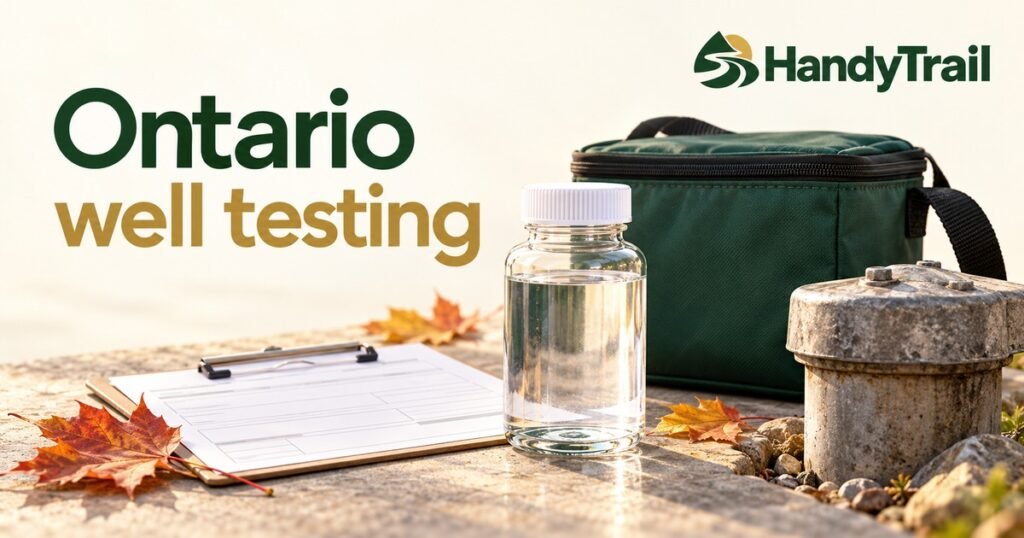
PHO uses its own collection kit. Pick it up from an appropriate local location and confirm the current drop-off arrangements before choosing a collection day. A health-unit collection point may have a pickup schedule that differs from the laboratory’s receiving hours.
Make a short route plan with collection time, travel time, receiving location and the last acceptable handoff. Ask the receiving service to confirm the timing for your actual kit. A neighbour’s experience from last year is not a current transport instruction.
The PHO portal FAQs explain the electronic submission route and report access. Save the bottle barcode and use consistent identity details. Paper and electronic arrangements should be followed as instructed, rather than completed twice with conflicting sample descriptions.
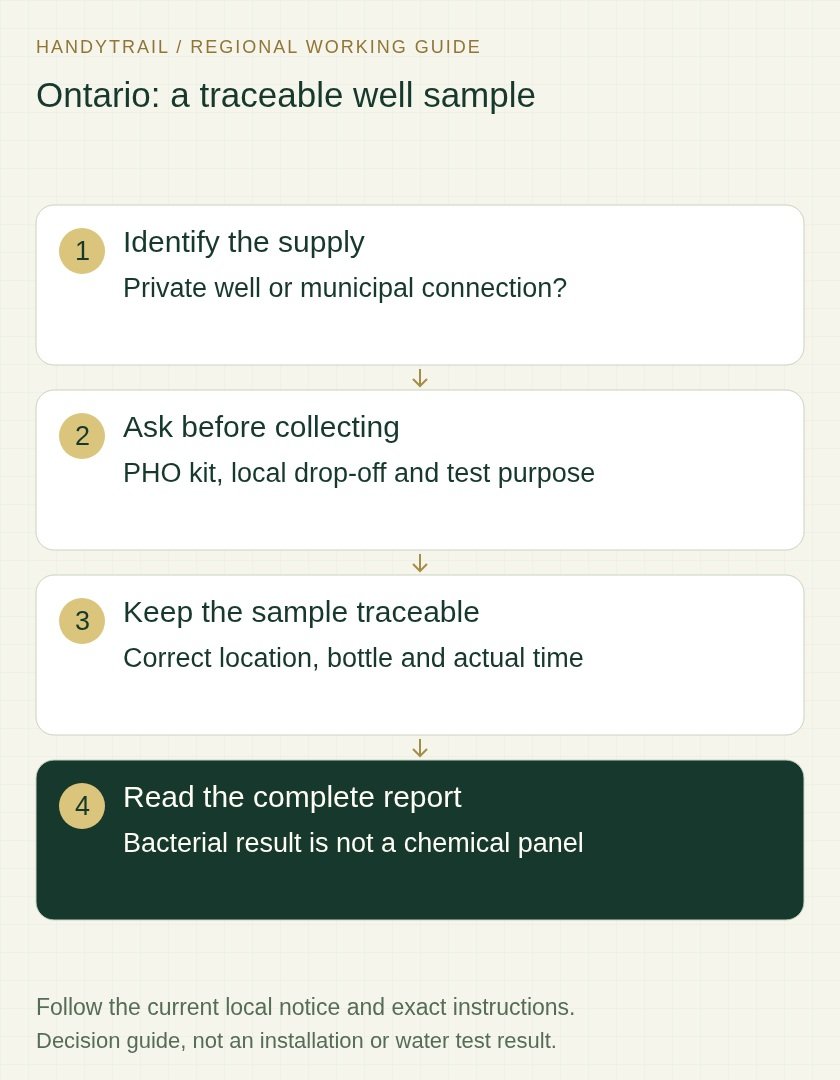
- Identify the supply. Private well or municipal connection?
- Ask before collecting. PHO kit, local drop-off and test purpose
- Keep the sample traceable. Correct location, bottle and actual time
- Read the complete report. Bacterial result is not a chemical panel
Describe the sampling point precisely
“Kitchen tap” can conceal important differences. Does it serve untreated well water, water after whole-house treatment or a separate drinking-water filter? Ask which location answers the question being investigated. Do not assume an outlet after a filter represents the raw supply.
Use the exact collection instructions for that test. This article does not replace faucet preparation, bottle handling or preservation directions. Do not rinse a supplied bottle or transfer water from another container. Record the actual collection event rather than writing in a planned time beforehand.
For example, a household investigating rain-related changes might have a bacterial collection requested at one outlet and a separate chemical panel requested elsewhere. Keep those instructions in separate labelled rows. Two bottles taken from different routes should not become one undifferentiated “well result.”
Make the plan local within Ontario
In Ottawa, Grey Bruce or another Ontario area, the useful regional detail is the responsible public health unit and its current collection arrangements. Postal location alone does not identify the well, test or pickup route. Use the address of the actual water source when the form asks for it.
The comparison below is a planning aid, not a list of active advisories. It does not claim that one Ontario community has a particular contaminant or that every listed office accepts samples on the same day.
| Ontario location | Local planning question |
|---|---|
| Ottawa and eastern Ontario | Which public-health drop-off serves this address? |
| Grey Bruce and surrounding rural communities | What is the current pickup schedule? |
| Other Ontario communities | Which PHO or health-unit location accepts the kit? |
If you are arranging a cottage sample while living elsewhere, distinguish the mailing address from the water-source address. Leave a copy of the instructions for the person actually collecting the sample. Make sure that person can identify the intended outlet and the correct bottle.
Handle a concerning or incomplete result
Read the result with the laboratory’s legend and any accompanying public-health advice. Ask about the meaning of the bacterial finding, the recommended water-use response and any follow-up inspection or sampling. Do not declare the supply restored merely because the next glass looks clear.
A rejected sample is not a negative result. If the lab reports missing information, an unacceptable container or a timing problem, ask what must change before recollecting. Keep that message in the file so the next attempt does not repeat the same error.
A result from after treatment also needs the equipment status recorded. A sample taken while a unit was bypassed cannot demonstrate that unit’s performance. Likewise, a single suitable result does not show how the well will behave after every future rainstorm.
Leave a useful record for the next test
Keep the well identifier if known, sampling location, treatment status, collection time, barcode, delivery details and complete report together. Add rainfall observations as context without calling them a proven cause of a laboratory result.
Before ordering treatment, separate a confirmed finding from an unresolved question. Ask what the proposed equipment is intended to address, how its suitability is supported and what follow-up would demonstrate the intended result. The practical outcome of this first check is a traceable test and an appropriate next step, not an automatic equipment purchase.
Frequently asked questions
Does a clear well sample mean it is safe?
No. Appearance cannot replace testing, and a bacterial test does not measure every chemical concern.
Can I use an ordinary bottle?
Use the collection kit required by the receiving laboratory. Follow its current collection and transport instructions.
Related practical guides
For background recordkeeping and equipment questions, these guides can help. The local authority and supplier instructions above govern the regional response.