A water report says “ND” next to a contaminant you wanted to investigate. That can look reassuring, but the letters are only part of the result. The useful question is what the laboratory could report for that particular analyte, using that method, in that sample.
Keep the result, units, limit and laboratory notes on the same page. This guide helps you prepare questions about a nondetect. It does not interpret an individual health risk or replace the laboratory’s explanation.
Start with the laboratory’s own legend
ND generally signals that the laboratory did not report a detection under its stated procedure. Ask how that lab defines the abbreviation. A method detection limit, a reporting limit and a quantitation limit are different concepts; do not substitute one for another because the numbers look similar.
The EPA’s guidance on detection limits in drinking-water monitoring shows why a nondetect has to be tied to an appropriate analytical limit. That guidance concerns compliance monitoring. It is not a universal decision rule for every private-well report.
On your copy, mark the analyte name exactly as printed. “Total” and a particular chemical form may identify different tests. Copy the result without changing a less-than sign into a zero. Save any footnotes, including notes about dilution or sample condition.
Read a hypothetical example in full
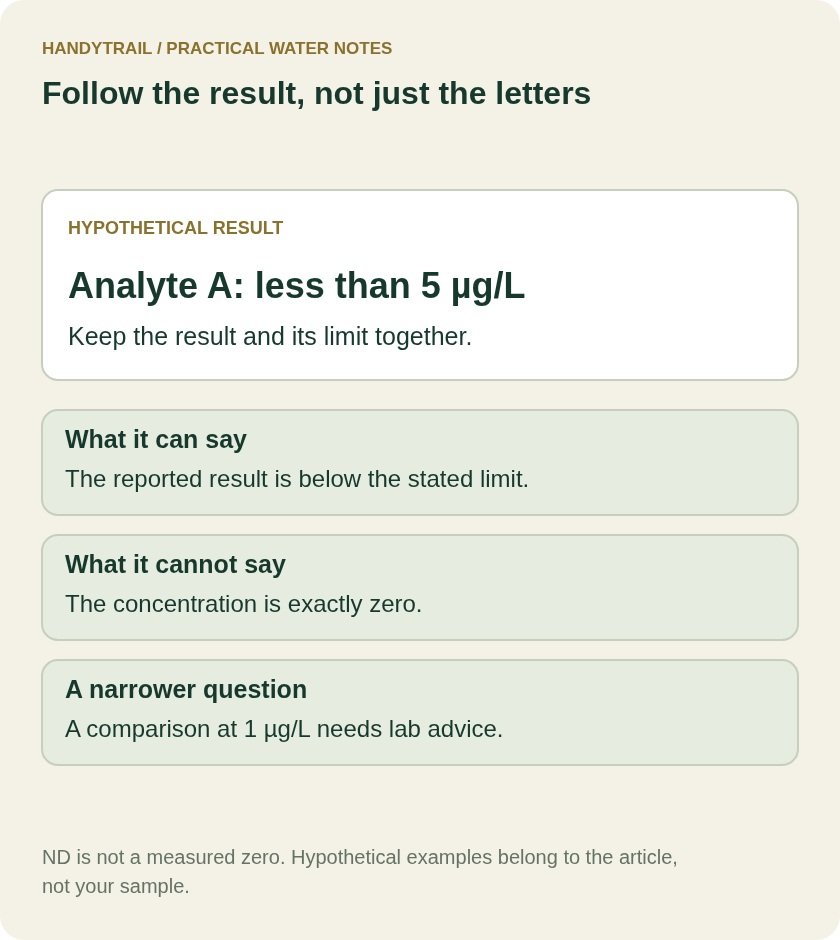
Suppose an invented report lists Substance A as “less than 5 micrograms per liter.” It supports a statement about the result relative to that laboratory’s stated limit. It does not establish that the concentration was exactly zero, and it cannot answer every question below that limit.
Now imagine a planning conversation asks whether the result can resolve a comparison at 1 microgram per liter. A less-than-5 result leaves that narrower question unanswered. The next step is to ask whether a suitable method can report at the needed level, rather than choosing a filter from the ND abbreviation.
These numbers are illustrative. Substance A is not a named contaminant, and neither number is a drinking-water standard. For a real substance, ask the laboratory and the relevant health or water authority which comparison applies to your situation.
- Copy the row: Analyte + result + units.
- Find the limit: Reporting limit + qualifiers.
- Check the question: Is the method suitable?
- Ask the lab: Interpret before deciding.
Working record
| Field | What to record |
|---|---|
| Analyte | Exact name and form |
| Result | Copy ND or < sign as printed |
| Units and limit | Name and value from lab |
| Method and notes | Copy qualifiers; retain legend |
| Decision question | What do you need to resolve? |
Make a small result-reading worksheet
Use one row per analyte. Include the full name, result as printed, unit, named limit, limit value, method and qualifier. Add two more fields: the question you ordered the test to answer, and the person who will help interpret it.
A row that contains only “ND” is incomplete for this purpose. A useful row might read “Substance A; <5; µg/L; lab reporting limit 5; method shown on report; dilution note attached.” The worksheet makes missing information visible without pretending to calculate a concentration.
If you compare old and new reports, put their rows beside each other. A change from ND to a number can reflect different analytical sensitivity, sample locations or procedures. Do not call it a confirmed increase until those details have been reviewed. Our guide to why two water test results can differ explains the wider comparison problem.
Check units before asking about a limit
A concentration written in milligrams per liter and one written in micrograms per liter require the same unit before a numerical comparison. One milligram equals 1,000 micrograms. For example, an invented 0.005 mg/L value equals 5 µg/L; changing the unit does not improve the test’s sensitivity.
Keep the original row and put any conversion in a separate note. Avoid converting a blank cell or ND alone into a number. The conversion belongs to the stated limit or reported concentration, not to an imagined amount below it.
Send focused questions to the laboratory
Ask what ND means on this report, which limit controls that notation, whether any dilution changed the reported limit, and whether the method fits the decision you need to make. Include the report identifier rather than a cropped screenshot of the result alone.
If you tested treated water, identify the sampling point and equipment status. If you tested untreated well water, say that clearly. “Kitchen water” is not enough to distinguish a bypassed filter, a drinking-water outlet or a whole-house treatment route.
Keep the full report with the next decision
Save the signed report, its legend, the laboratory’s reply and any follow-up plan. If a result cannot resolve your question, ask about suitable retesting before spending money on a treatment claim. A product’s certification still needs to match the exact substance and model; an ND does not turn a general filter claim into verified performance.
Practical questions
Does ND mean the concentration is zero?
No. Read the laboratory’s definition, stated limit, units and qualifiers. Ask the lab whether the result can answer your particular comparison question.
Can I compare two ND results directly?
Only after checking that the analyte, units, limits, sampling locations and procedures are suitably comparable. Keep the full reports and ask about differences.
Should I choose a filter from an ND abbreviation?
An abbreviation alone does not identify a treatment need or verify a product claim. Resolve the laboratory interpretation and then assess any exact model claim against the measured concern.