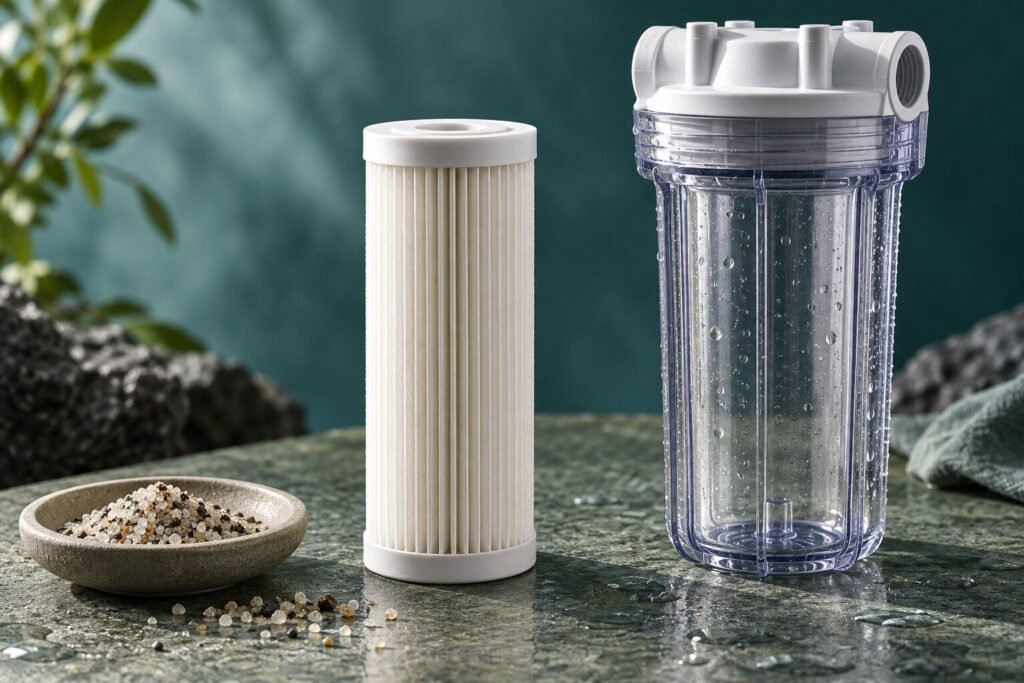
A typical sediment filter is intended to catch particles. It isn't a water softener and shouldn't be assumed to remove dissolved hardness minerals or every dissolved contaminant. Water can look clearer after filtration and still have essentially the same hardness problem.
Before changing cartridges, identify what you're trying to remove. Visible grit and a laboratory result for a dissolved substance need different treatment questions.
A particle and a dissolved substance aren't the same
Sand-like material can be trapped by a suitable physical filter. Dissolved substances are present in a different form. A water-treatment technology that captures particles doesn't automatically provide a documented reduction claim for a dissolved chemical.
CDC explains that filters differ in the germs and chemicals they can address. The relevant product information and verified claims matter more than a general label such as fine filtration.
Don't turn visible sediment into a diagnosis of the entire supply. Material can originate in different places, and its appearance doesn't identify every constituent. The sediment investigation guide helps organize where and when the problem appears.
Clear water can still be hard
Hardness mainly concerns dissolved calcium and magnesium. CDC describes softening as a method for reducing hardness minerals. A conventional sediment cartridge doesn't perform that ion-exchange job.
If the problem is scale, get a hardness test at the appropriate sampling point. Keep the units and treatment status with the result. Looking through a clear housing isn't a hardness measurement.
A deposit that forms when water dries or is heated can look solid, but that doesn't mean those minerals entered the cartridge as catchable grains. This is why a smaller micron rating isn't a general solution to every mineral complaint.
What a micron rating can tell you
A stated particle rating describes part of the filter's intended performance. Nominal and absolute descriptions, test conditions, and product limits need to be read carefully. Our micron-rating guide explains those differences.
The number doesn't establish that the filter removes dissolved sodium, nitrate, lead, or another chemical. Ask for a specific supported claim if a seller proposes the cartridge for one of those jobs.
Flow and pressure limits also matter. A cartridge with a finer rating isn't automatically the right choice for the system or household demand.
Don't use a TDS reading as a filter verdict
A handheld TDS meter estimates a property related to dissolved ions. It isn't a universal drinking-water safety test and isn't the same as a particle count.
A similar reading before and after a sediment filter doesn't, by itself, show that the filter failed at capturing its intended particles. A lower reading doesn't prove that every relevant contaminant was removed either. See our TDS-meter guide for the limits.
Judge the treatment against its intended job using the right evidence. That may include an operating check, a suitable sample, or manufacturer-specified performance information.
Choose the next component only if it has a job
If both particles and another water problem are present, more than one treatment task may be appropriate. Their order and operating limits depend on the source water and the equipment. Don't copy a universal filter chain from an illustration.
Ask the provider what each component does, what evidence supports it, and how it will be maintained. For a well, the treatment-order guide explains why the arrangement varies.
Keep the conclusion specific
A sediment filter can be useful without solving every water question. Maintain it according to its instructions and investigate changes in performance. Don't wash or reuse disposable media unless the exact documentation allows it.
The practical question is not whether the water looks clean. It is whether the filter addresses the particular particles or other documented concern you selected it for.
When the concern is cloudiness rather than visible grit, describe the clearing pattern in a clean glass before assuming a sediment cartridge is the right purchase. That observation can guide the next question without proving safety or identifying every cause.