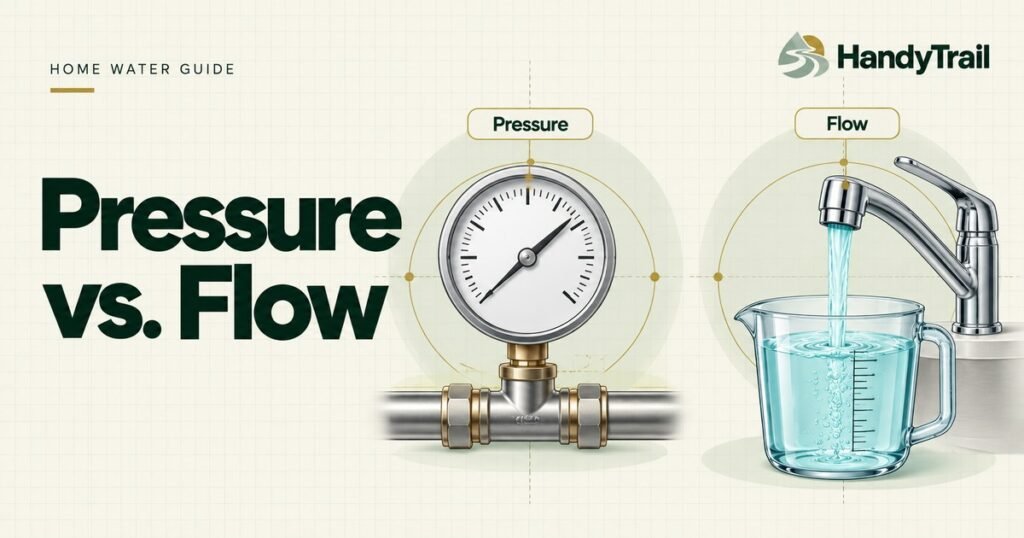
A faucet can feel weak even when a pressure reading looks normal. That is not necessarily a contradiction. Pressure describes force per unit area within the water system. Flow describes how much water passes through an outlet over time. A restriction, a small opening or a change in household demand can affect the water arriving at a fixture without making every pressure measurement tell the same story.
Before buying a pump, replacing a filter or adjusting a regulator, build a clearer description of the problem. Record where it happens, what else is running and whether it began after a change. Those observations give a plumber something more useful than “the pressure is bad.”
What pressure and flow tell you
Pressure is usually reported in pounds per square inch in US household plumbing. A gauge measures pressure at its connection point under the conditions present at that moment. The number does not describe every fixture, every time of day or every part of the installation.
Flow is a volume delivered over time, commonly expressed in gallons per minute. You may notice it as how quickly a container fills or how much water reaches a shower. A household observation is not a laboratory performance test, but it can help describe a change.
Think of the two measurements as different questions. A pressure reading asks what force is available here now. A flow observation asks how much water reaches this outlet under these conditions. Neither, by itself, identifies the cause of a problem.
Start with the pattern around the house
Compare cold and hot water at the affected fixture without changing equipment settings. Note whether another nearby fixture behaves differently. If the problem appears at one faucet, write that down. If several fixtures change together, record which ones and whether they share an obvious use pattern.
Try to recall the first noticeable event. Was a cartridge replaced, a valve serviced, a new fixture installed or utility work announced? A sequence is useful evidence, although it does not prove that the most recent work caused the problem.
Distinguish a steady reduction from an intermittent one. A faucet that slows only while the washing machine fills presents a different pattern from a faucet that remains slow all day. Supply conditions and simultaneous use matter when someone tries to reproduce your observation.
Give an observation enough context
A short log can reduce repeated visits and guesswork. Record the date, time, fixture, hot or cold setting and other active water uses. If you safely compare fill times, use the same container and the same fixture setting each time. Keep the container stable and avoid hot water that could cause a burn.
Do not turn an informal measurement into a declared system rating. Containers have imperfect markings, faucet settings vary and water use elsewhere can change during the observation. Report the method and the result together so the person reviewing them understands the limits.
| Observation | Helpful detail | What it does not establish |
|---|---|---|
| One faucet is slow | Hot, cold or both, plus when it began | The condition of the entire supply |
| Several fixtures slow together | Other water uses running at that time | A specific failed component |
| Flow changed after filter service | Exact model, cartridge and service date | That the cartridge alone caused it |
| A gauge reading changes during use | Connection location and active fixtures | A universal household pressure limit |
| The pattern varies by time of day | Comparable observations on several days | The utility's cause without investigation |
An equipment record can hold these notes alongside manuals and service history. Use the water equipment record if your home has several filters, valves or treatment devices and their locations are easy to confuse.
A regulator controls pressure, not every restriction
A pressure-reducing valve can control downstream pressure within the capabilities of its particular design. For example, Watts describes its LF25AUB-Z3 as reducing incoming pressure to a predetermined downstream level. That description explains its job. It does not mean this model is suitable for every home or that a homeowner should change an adjustment.
A regulator cannot make a blocked passage disappear. Nor does its presence prove that the current setting, installation or operating condition is correct. A plumber needs to consider the supply, equipment, measurements and local requirements together.
Avoid using a number found on a product page as the permitted pressure for your own home. A manufacturer's range belongs to that product. Local code, equipment limits and the installed system may impose different requirements. Ask the person measuring the system which requirement applies and where it comes from.
Keep filter claims in their operating context
A filter's advertised flow rate should be read alongside the exact system and cartridge, test conditions and operating limits. “High flow” in a product title is not enough to predict performance in a home with different demand or a different installation.
If the problem followed replacement work, check the records rather than taking the housing apart again. Confirm the named replacement cartridge and retain the service instructions. Our low-flow guide after a filter change covers that specific troubleshooting record without treating every slow fixture as an exhausted filter.
A performance data sheet can describe contaminant reductions under stated conditions. It should not be read as a promise that every household fixture will deliver the same volume after installation. Keep the water-quality purpose of treatment separate from the plumbing question you are trying to resolve.
Ask for measurements that answer your question
When arranging service, describe the problem before requesting a particular replacement. Ask where pressure will be measured, whether readings will be compared with water at rest and during use, and which fixtures or treatment devices need to be considered.
Request that the findings identify the measurement location and conditions. “Pressure checked” on an invoice is less useful than a recorded reading with the circumstances that produced it. You should also know whether the proposed repair addresses a confirmed fault or is an exploratory step.
If a contractor recommends a pump or regulator, ask what evidence supports it, what installation requirements apply and how the result will be checked afterward. The treatment quote comparison worksheet can help separate an initial price from installation scope and recurring costs when treatment equipment is part of the proposal.
A fill-time example makes the units clearer
Suppose a measured one-gallon container fills in 30 seconds. That corresponds to two gallons per minute. If the same volume takes 15 seconds, the observed rate is four gallons per minute. These are arithmetic examples, not target rates for your faucet or a claim about a tested home.
To convert a suitable observation, multiply the collected US gallons by 60 and divide by the number of seconds. Record the volume, time and conditions alongside the answer. Do not compare a partially opened faucet with a fully opened one and treat the difference as a change in the supply.
Neither example gives a pressure reading. You could describe how fast the container filled without knowing the pressure at the fixture. Keep any gauge measurement as a separate entry with its connection point and whether water was running elsewhere. That distinction helps avoid buying a pressure-control device for a problem that has not yet been identified.
Know when the observation log can wait
An active leak, a damaged pipe or an unsafe electrical condition is not an occasion for repeated flow experiments. Stop using affected equipment when appropriate and seek help through your utility, property manager or qualified service provider. Do not operate an unfamiliar valve simply to see what happens.
For an ordinary recurring complaint, your best next step is a reproducible description. Keep the observations short, preserve the equipment details and let measurements guide the diagnosis. That makes it easier to choose a repair for the actual problem instead of buying equipment for a vague feeling at the tap.
For a problem confined to one tap, see the faucet-aerator check. A bang when flow stops needs a different investigation, covered in the water-hammer guide. For pressure changes during heating, compare regulators and expansion tanks and the separate water-heater noise checks.