The cost of a private-well water test depends on what is being analyzed and which services are included. A price for laboratory analysis is not automatically the price of a professional sampling visit, a well inspection or an explanation of the results.
Ask for an itemized quotation before comparing providers. Start with the question the test must answer, then match the analytes, sampling requirements and service scope. The lowest package total is not a useful comparison when the packages investigate different things.
Define the test before asking for a price
Tell the laboratory whether the request is routine household testing, a change in the water, follow-up after work, or a transaction with specified requirements. Ask which analyses fit the concern and whether the report will be accepted for the intended purpose.
The CDC’s well-testing guidance explains why both regular testing and particular events matter. It does not establish one universal laboratory package for every well or one national fee. Local geology, land use and the actual event can lead to additional questions.
Write the requested analytes in the quotation. A label such as “basic test” or “complete panel” is not enough. Ask about methods and reporting limits where they affect the decision, and keep any lender, agency or transaction requirement separate from a general household screening panel.
Read real published prices with their scope
As checked on October 15, 2026, the University of Wisconsin–Stevens Point laboratory’s well-testing page lists a Homeowner Package at $78 and a Comprehensive Homeowner Package at $191. These are dated examples from one Wisconsin laboratory, not a US average or a promise of a price available from your nearest provider.
The comprehensive offer includes additional packages, so the difference is not simply a higher charge for identical work. The page also states limitations on using certain results to evaluate Safe Drinking Water Act compliance. Confirm the current analytes, suitability and total before ordering.
Do not turn $78–$191 into a national “typical range.” A targeted analysis elsewhere, a different panel or a professional site visit may have a different price and purpose. Use the example to see why package contents and acceptance requirements belong beside the number.
Separate laboratory work from getting the sample there
Ask whether the price covers the kit, analysis, collection labor, travel, courier service and interpretation. A lab may provide collection bottles while still requiring a particular return arrangement. Do not assume that all delivery or visit expenses are included because a kit is mailed to you.
If you collect the sample yourself, use the laboratory’s procedure and acceptance plan. If a technician collects it, confirm what the visit covers. A sampling appointment is not necessarily a mechanical inspection of the well or a pump-performance assessment.
For a testing service described as “near me,” check the actual collection area and receiving laboratory. The address of a salesperson or booking office does not establish where the analysis occurs or whether the laboratory handles the required test.
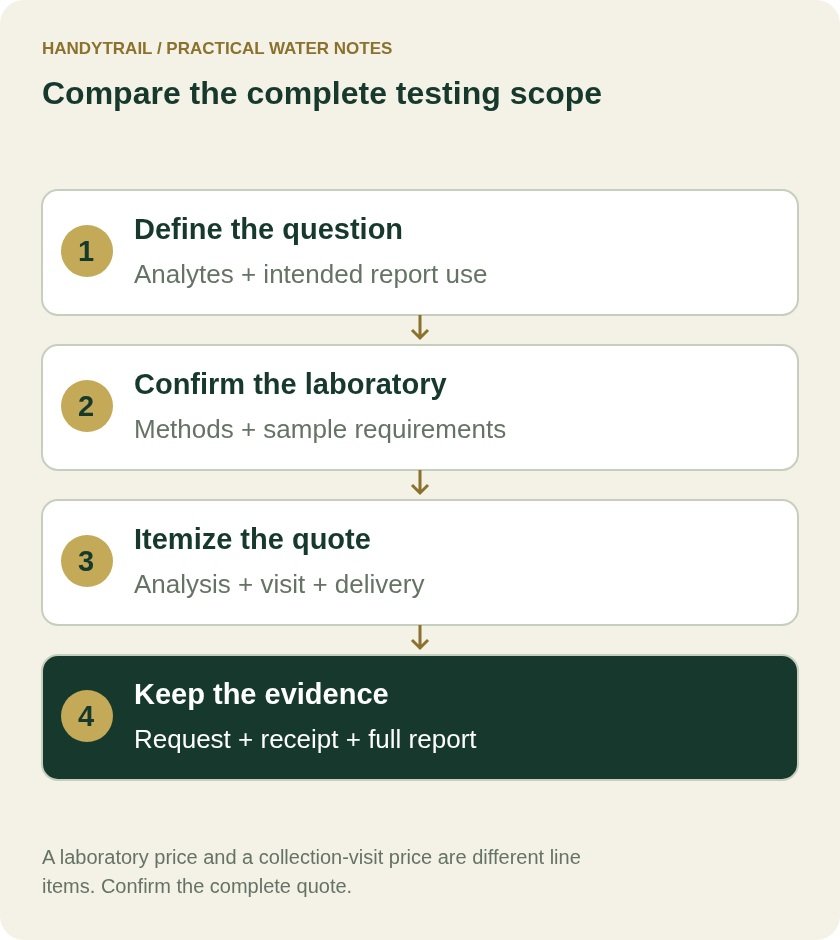
- Define the question: Analytes + intended report use.
- Confirm the laboratory: Methods + sample requirements.
- Itemize the quote: Analysis + visit + delivery.
- Keep the evidence: Request + receipt + full report.
| Line item | Question to resolve |
|---|---|
| Analysis | Which named analytes, methods and reporting scope? |
| Collection visit | Is it included, optional or separately charged? |
| Kit and delivery | Which dispatch and return costs are included? |
| Report and explanation | Who provides them, and for what intended use? |
| Extras | Travel, rush work and possible rechecks quoted separately? |
Build a comparison with the same line items
Make columns for Provider A and Provider B. Under each, list the analytes, laboratory identity, collection method, kit charge, analysis charge, visit and travel, return delivery, report explanation, turnaround and any specified rush fee. Mark unknown items as unknown rather than entering zero.
A hypothetical quote might state $120 for analysis, $80 for a collection visit and $25 for delivery. The entered total is $225 before any other stated charge. These figures are invented arithmetic, not market estimates. A second $150 analysis-only offer cannot be called $75 cheaper until collection and delivery requirements are compared.
Keep rechecks and follow-up samples as separate possible work. Ask when another sample might be recommended and how it would be quoted. Do not assume an abnormal result includes a free repeat or that a repeat makes the original result irrelevant.
Ask what the report and consultation provide
Confirm whether you receive a laboratory report directly, a service summary or both. Ask who explains units, qualifiers and the next step. A salesperson’s treatment proposal is a different document from the laboratory’s analytical findings.
A useful consultation identifies the sample point, what was tested and what remains outside the panel. It should not turn one passing result into a statement that every possible concern has been excluded. Save the report, original request and collection record together.
For an urgent concern, ask the relevant local authority what water-use instructions apply while investigation proceeds. A lower-cost package or faster sales appointment should not replace those instructions.
Use local programs without assuming free testing
County, extension or community programs may offer particular tests or collection arrangements. Check eligibility, dates, included analytes and the laboratory used. An advertised screening event may not meet a separate transaction requirement or cover the contaminant you want to investigate.
The practical purchasing order is to define the question, confirm an appropriate laboratory and procedure, compare complete service costs, and retain the evidence. That produces a more useful budget than a single nationwide price attached to the phrase “well-water test.”
Frequently asked questions
How much does a private-well water test cost?
It depends on the analytes and service scope. This guide gives dated examples of $78 and $191 packages at one Wisconsin laboratory, not a national range. Confirm analysis, collection, delivery and report requirements in your own quote.
Is a sampling visit included in a laboratory panel price?
Not automatically. Ask whether collection labor, travel, kit and return delivery are included. A sampling visit also is not necessarily a mechanical inspection of the well.
Is the most expensive panel always the right test?
No. Choose analyses around the intended question, local risks and any specified report requirements. Compare packages only after their contents and purposes are clear.
Related guides
- How to choose a certified drinking-water laboratory
- How to prepare a water sample for a lab
- How to read a well-water lab report