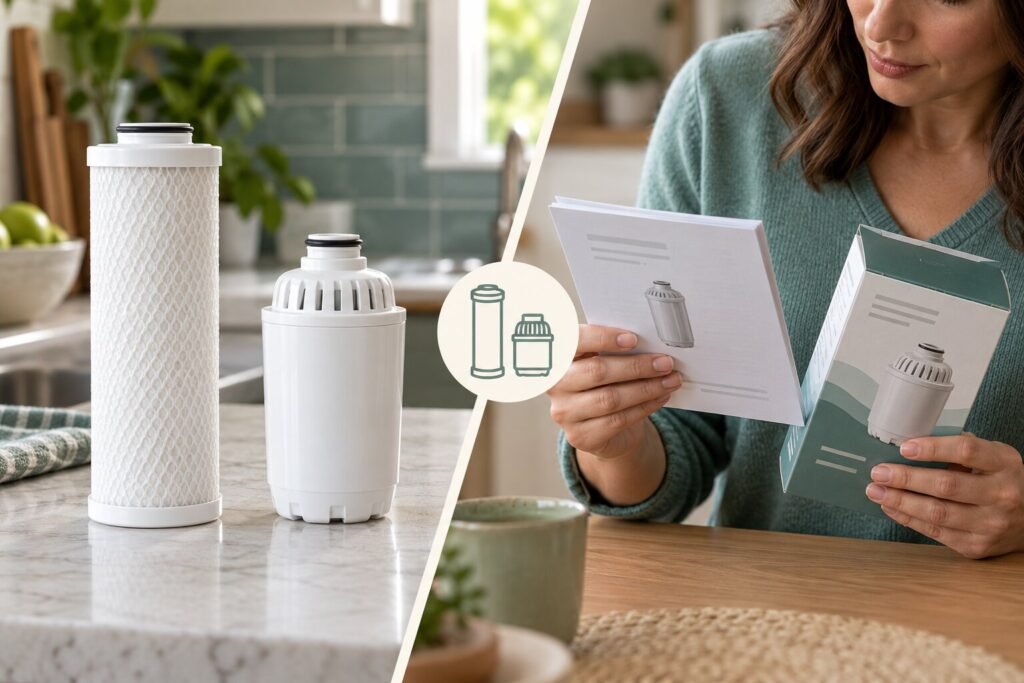
A replacement cartridge needs to fit the equipment and perform the required treatment job. Those are separate checks. Similar dimensions, a familiar color, or the phrase compatible with doesn't establish that two cartridges have equivalent contaminant-reduction claims.
Start with the equipment model and the specified replacement part. Keep the manual available while shopping, rather than buying from a picture and hoping the connection will work.
Build a short identification list
Record the housing or appliance model, the current cartridge part number, and any permitted alternatives in the manufacturer's documentation. Photograph accessible labels before disposing of the used cartridge.
Dimensions matter, but so do connections, sealing arrangements, operating limits, and the intended application. A cartridge that fits inside a housing isn't automatically approved for the whole assembly.
Don't remove a housing or disturb a pressurized connection just to read a number you can't see. Our housing care guide explains why service instructions and the right parts matter.
For a faucet-mounted system with a collar leak, use the faucet-filter collar guide to review the correct washer and model-supported fit. Do not use extra force to compensate for an uncertain replacement.
Compare the job, not just the appearance
A sediment cartridge, a carbon cartridge, and an RO membrane serve different purposes. Even within one format, the reduction claims can differ. Ask what contaminant or property the replacement is intended to address.
CDC advises matching the filter to the concern and checking its claims. Use the certification guide to verify the exact model or assembly, rather than treating a logo in a seller's photo as proof.
A performance claim for a cartridge in one tested system doesn't automatically cover every housing it can physically enter. Check the scope of the listing and the manufacturer's compatibility information.
Read an equivalent claim carefully
Ask the seller what equivalent means. It could mean physical fit, a similar material, a claimed flow rate, or a particular reduction claim. Those aren't the same promise.
Keep a written record of the stated compatibility and the relevant listing. If the seller can't identify the model and evidence behind a safety-related claim, don't fill the gap with assumptions.
A low price doesn't prove a part is unsuitable, and a high price doesn't prove it is suitable. The useful evidence is specific to the equipment and the treatment task.
Verify the operating limits
Check the permitted temperature, pressure, flow, and replacement schedule in the documentation. Don't carry over the limits from an old cartridge without checking the new one.
A flow change after installation deserves investigation. Follow the specified startup and flushing procedure and check for leaks using the manufacturer's directions. Our low-flow guide helps organize the symptoms without treating them as proof of one failed component.
If installation requires unfamiliar plumbing work or pressurized housing service, get qualified help. Don't trim a cartridge, improvise a seal, or force a connection to make an uncertain part fit.
Keep the next replacement simple
Save the approved part number, manual, verified claim, and replacement limits together. Our replacement planner can translate stated calendar and volume limits into a planning reminder. It doesn't test the cartridge or override an earlier service instruction.
Also record what you actually installed and when. The equipment record gives the next person servicing the device a useful starting point.
An unpaid equipment example
Pentair's WH5 housing product information illustrates why the housing model belongs in the record. Use the documentation for the exact equipment you own; this mention isn't a recommendation that the housing suits every water problem or cartridge.
HandyTrail isn't paid for this example. The same compatibility questions apply when comparing other manufacturers. Choose a replacement by its documented fit and job, not by how convincingly a product photo resembles the old one.
Refrigerator cartridges require the appliance model as well as a plausible-looking filter. The refrigerator replacement checklist covers identification, supported claims, installation and the specified flush.
Sources and further reading
If cartridge service also involves changing plumbing connections, check the separate requirements for those parts. Review lead-free brass content and material standards and the push-to-connect fitting checks instead of treating physical fit as complete verification.